Published Feb 2026
A Defensive Cycle: What Investors Should Know About Thailand’s Banking Sector
Thailand’s banking system in 2025 tells a story of strength and caution at the same time. While capital buffers remain solid and systemic risk is low, credit growth is slowing, profitability is under pressure, and household debt continues to weigh on expansion. This article explores what these trends mean for investors, bankers, and risk analysts looking to understand the true direction of Thailand’s financial sector.
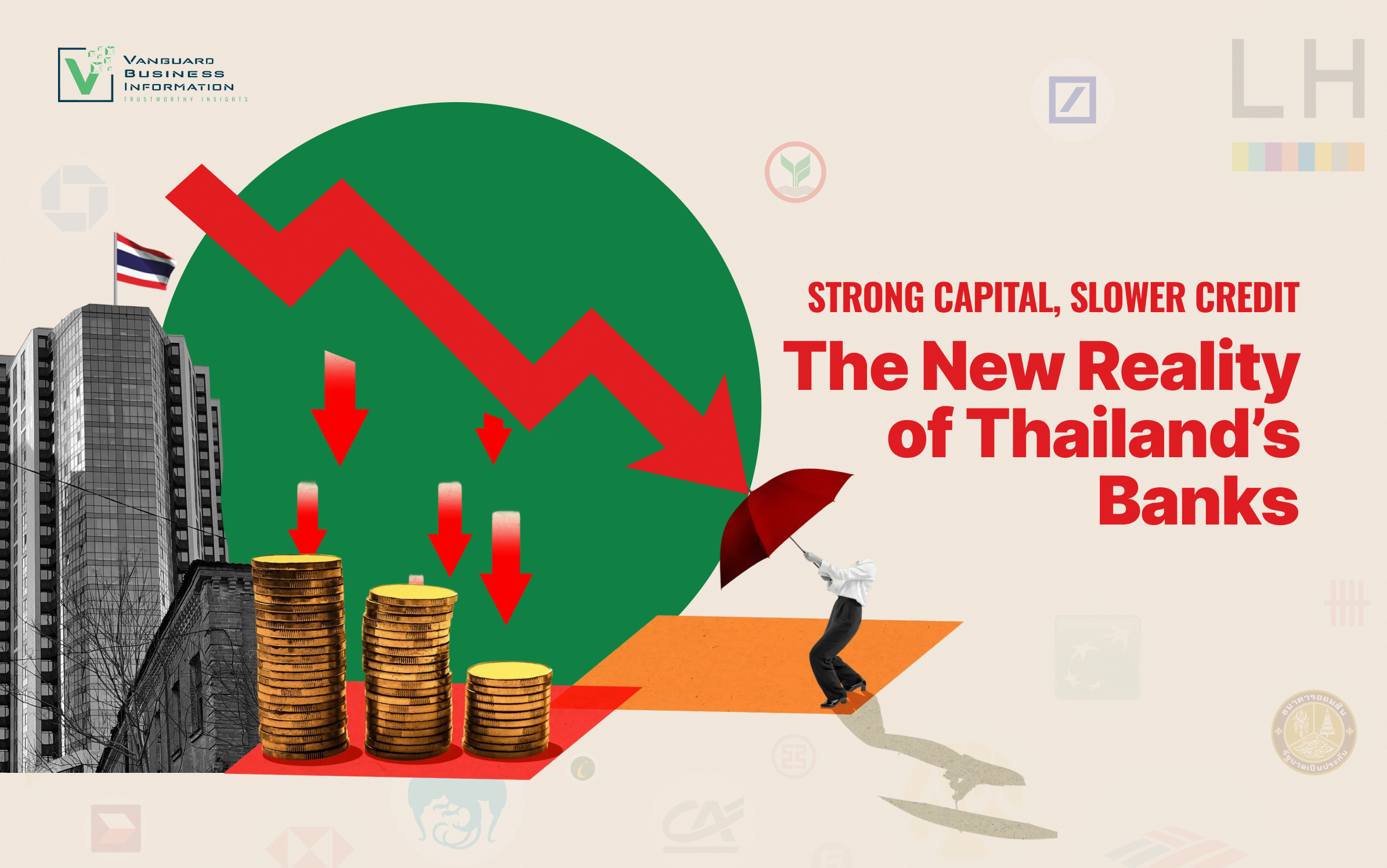
Thailand’s banking system stands at an interesting crossroads. On paper, it is one of the most resilient in Southeast Asia well-capitalized, liquid, and tightly supervised. Yet beneath that stability lies a more cautious reality: credit is shrinking, profitability is narrowing, and households remain heavily indebted.
The latest quarterly assessment from the Bank of Thailand confirms a sector that is stable, but no longer in expansion mode. For investors, bankers, and risk analysts, understanding this balance between strength and slowdown is essential before committing capital or extending credit in the Thai market.
A System Built on Strong Capital and Liquidity
If there is one message the Thai banking data sends clearly, it is that systemic risk is low. Capital ratios remain comfortably above regulatory requirements, liquidity buffers are ample, and loan-loss provisions are robust.
Thai banks are not facing solvency pressure. They have built significant shock absorbers over the past decade, learning from past crises and the pandemic period.
For foreign investors, this matters. Thailand’s banks are not vulnerable to sudden collapse or capital shortfalls. The system’s foundation is strong. But strength alone does not guarantee growth.
Credit Growth Has Turned Defensive
The more telling story in 2025 is not about capital, it is about contraction.
Overall lending has declined, reflecting weak demand and heightened risk sensitivity. Businesses are borrowing less, especially small and medium-sized enterprises. Even large corporates have shown limited appetite for expansion credit, consistent with a below-potential economic environment.
On the consumer side, housing loans have shown modest resilience, but other retail segments remain cautious. Banks are not aggressively chasing growth; instead, they are managing risk and preserving asset quality. This signals a system in defensive posture. Thailand’s banks are not facing a liquidity shortage; they are navigating a demand slowdown and structural income constraints across the economy.
SMEs: The Pressure Point of the System
The divergence between large corporates and SMEs is striking.
Large corporations appear broadly stable. Their credit profiles have not deteriorated materially. SMEs, however, remain the most vulnerable segment. Elevated credit risks, weaker income buffers, and sensitivity to domestic demand have kept banks cautious toward this group.
Although non-performing loan ratios have improved overall, much of the improvement has come from repayments and active portfolio management rather than a surge in new credit expansion. This distinction is important.
For lenders and investors, SME exposure requires detailed, sector-specific due diligence. Tourism-related, export-dependent, and consumer-sensitive sectors may face uneven recovery paths.
Profitability Is Under Quiet Pressure
Even in a stable banking system, earnings tell a different story. Bank profitability has declined compared to the previous year. Lower interest rates, narrower lending margins, and weaker loan growth have weighed on net interest income.
While banks have partially offset this through investment gains and non-interest income streams, core profitability has softened. Returns on assets and equity have edged lower, reflecting a slower credit cycle.
This does not indicate crisis but it does signal that the era of easy margin expansion is over. Thai banks are transitioning toward more fee-based, efficiency-driven models rather than relying solely on credit growth.
Household Debt: Thailand’s Structural Constraint
Perhaps the most critical macro-financial variable in Thailand is household leverage.
Household debt remains high relative to GDP, well above what many analysts consider a comfortable threshold. Although the ratio has stabilized in recent quarters, it remains elevated, limiting the capacity for aggressive consumer-led credit expansion.
The composition of household debt (with a large share in mortgages and personal loans) underscores the vulnerability of income-sensitive borrowers.
If economic growth remains uneven, debt-servicing capacity could weaken. That risk explains why banks are maintaining strict underwriting standards and continuing debt restructuring programs. For investors, this is the core structural risk in Thailand’s banking landscape: not bank fragility, but borrower fragility.
Debt Restructuring: A Silent Stabilizer
One of the defining features of Thailand’s post-pandemic banking environment has been proactive debt assistance.
Millions of accounts remain under restructuring or support measures, and trillions of baht in loans are covered by assistance programs. These initiatives have prevented a sharp spike in defaults and helped smooth the credit cycle.
However, restructuring is both a shield and a signal. It protects the system in the short term, but it also reveals where stress remains embedded. For analysts, monitoring how restructured loans perform over time will be a key indicator of whether Thailand’s credit cycle stabilizes or deteriorates.
A Broader Perspective: Stability Without Acceleration
Zooming out, Thailand’s banking system reflects the broader Thai economy: stable, disciplined, but growing below its full potential. The regulatory framework is credible. The central bank’s oversight remains strong. Capital buffers are substantial.
Yet structural challenges, aging demographics, moderate productivity growth, household leverage, and uneven sectoral recovery, limit aggressive expansion.
This creates a banking system that is resilient but cautious. It is unlikely to deliver explosive credit growth in the near term, but it is also unlikely to experience systemic instability.
What This Means for Investors and Bankers
For international investors, Thailand offers a low systemic-risk banking environment with moderate cyclical headwinds.
Bank equities may trade on stable fundamentals rather than high-growth expectations. Corporate lending opportunities remain attractive in well-capitalized large firms. SME lending requires careful segmentation and credit modeling. Retail credit expansion will depend heavily on the recovery of household incomes.
In short, Thailand’s banking system in 2025 is defined not by crisis, but by recalibration. It is a system protecting its balance sheet while waiting for stronger economic momentum.
For investors and financial institutions seeking deeper corporate intelligence across Southeast Asia (including Thailand and Vietnam) Vanguard Business Information LLC provides comprehensive business information, financial analysis, and risk assessment services through www.vnbis.com, supporting informed decision-making across Asian markets.