Published Mar 2026
Malaysia Trade Surplus Hits RM21.4 Billion in January 2026
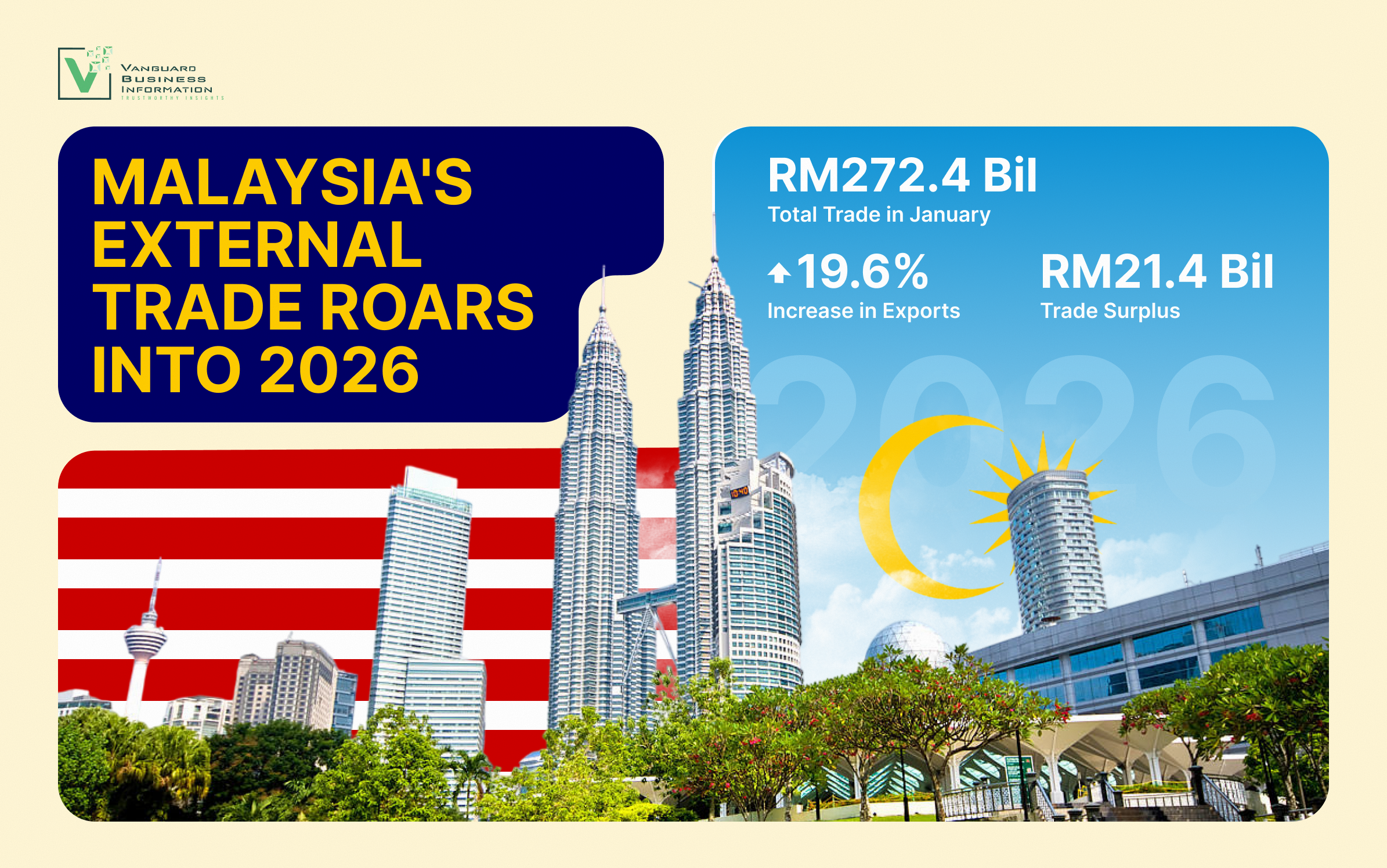
Malaysia’s external trade roared into 2026 with powerful momentum. In January alone, total trade surged to RM272.4 billion, exports jumped 19.6%, and the trade surplus widened sharply to RM21.4 billion. Driven by strong manufacturing performance and resilient ASEAN demand, the latest data reveals a confident, export-led economy gaining traction in a volatile global environment. Here is a data-driven breakdown of the numbers that matter most.
Malaysia’s external trade performance in January 2026 signals a powerful start to the year, with double-digit growth in total trade and a sharply widened trade surplus. According to the Monthly External Trade Statistics, January 2026released by the Department of Statistics Malaysia, total trade expanded significantly year-on-year, underpinned by strong export growth and steady import expansion.
This article highlights the most critical data points, sectoral trends, trading partner dynamics, and structural insights from the report, providing a data-driven and SEO-optimized overview of Malaysia’s trade performance.
Total Trade Reaches RM272.4 Billion, Up 12.6% Year-on-Year
Malaysia’s total merchandise trade in January 2026 rose by 12.6% year-on-year, increasing by RM30.4 billion to reach RM272.4 billion.
Exports surged by 19.6% to RM146.9 billion, representing an increase of RM24.1 billion compared to January 2025. Meanwhile, imports grew more moderately, rising 5.3% to RM125.5 billion. The result was a trade surplus of RM21.4 billion, widening by RM17.7 billion compared to the same month a year earlier.
This widening surplus is one of the most significant takeaways from the report. The faster pace of export growth relative to imports indicates strong external demand for Malaysian goods and improving competitiveness in key sectors.
However, on a month-on-month basis, exports, imports, total trade, and the trade balance recorded slight declines compared to December 2025. This suggests some short-term moderation, possibly due to seasonal effects or global trade volatility, but the year-on-year trajectory remains firmly positive.
Export Growth Outpaces Import Expansion
The data shows a clear asymmetry between export and import performance. Exports grew nearly four times faster than imports on a year-on-year basis, 19.6% versus 5.3%.
This divergence is critical for several reasons:
- It strengthens Malaysia’s current account position.
- It improves foreign exchange inflows.
- It signals resilience in export-oriented industries.
The ability to maintain robust export growth while imports rise at a slower pace indicates that Malaysia’s manufacturing and commodity sectors are responding effectively to global demand conditions.
Manufacturing Sector Remains the Backbone of Trade
Sectoral performance data confirms that manufacturing continues to dominate Malaysia’s external trade structure.
In January 2026, manufacturing exports amounted to RM127.4 billion, while manufacturing imports totaled RM106.9 billion. Export growth in manufacturing reached 22.3% year-on-year, while imports increased by 5.4%.
This highlights two major structural insights.
First, Malaysia remains deeply integrated into global manufacturing value chains. Second, export-driven manufacturing is generating substantial trade surpluses.
The large surplus within the manufacturing category reflects strong performance in electrical and electronic products, machinery, and industrial goods, sectors traditionally central to Malaysia’s export profile.
Mining and Agriculture: Supporting Roles in External Trade
While manufacturing dominates, mining and agriculture also contribute meaningfully to trade flows.
Mining exports stood at RM8.8 billion, while imports were RM8.7 billion. Agriculture exports reached RM8.9 billion, and imports totaled RM7.3 billion.
Although smaller in scale than manufacturing, these sectors play important stabilizing roles, particularly in commodity markets, where price movements significantly affect trade values.
ASEAN Remains a Key Trading Partner
Malaysia’s trade with ASEAN continues to be strategically important.
In January 2026, exports to ASEAN totaled RM39.4 billion, while imports from ASEAN reached RM28.4 billion. ASEAN accounted for 24.9% of Malaysia’s total trade.
This reinforces ASEAN’s position as Malaysia’s largest regional trading bloc partner. The strong trade surplus with ASEAN also contributes meaningfully to the overall RM21.4 billion trade balance.
Deep intra-regional supply chain integration remains a core pillar of Malaysia’s trade strategy.
Imports by Broad Economic Categories: Investment Signals
The report provides further insights by classifying imports according to Broad Economic Categories, a framework that reveals the underlying purpose of imported goods.
Key import values include capital goods of RM15.8 billion, intermediate goods of RM57.7 billion, and consumption goods of RM11.7 billion.
The large share of intermediate goods suggests continued manufacturing activity and supply chain integration. Meanwhile, capital goods imports reflect investment activity in machinery and equipment, an indicator of future productive capacity expansion.
These patterns suggest that Malaysia’s import structure supports long-term industrial development rather than short-term consumption-driven growth.
Trade System, Data Sources, and Statistical Integrity
The publication adopts the general trade system for recording statistics, meaning all goods entering or leaving Malaysia’s national boundary are included, including those in bonded warehouses and Free Zones.
Exports are recorded at the state of origin, defined as the location where the final stage of production occurs, while imports are recorded at the state of final destination.
Data sources include customs declarations approved by the Royal Malaysian Customs Department and Free Zone Authorities, along with other official reporting mechanisms.
This methodological transparency enhances the reliability and comparability of Malaysia’s external trade data.
Trade Balance and Macroeconomic Implications
The trade balance is defined as the difference between exports and imports. With exports of RM146.9 billion and imports of RM125.5 billion, Malaysia recorded a surplus of RM21.4 billion in January 2026.
A widening trade surplus of this magnitude has several macroeconomic implications.
It strengthens the Malaysian ringgit, supports fiscal revenues linked to trade-related activities, enhances investor confidence, and provides a buffer against global economic uncertainty.
Month-on-Month Moderation: A Temporary Adjustment?
Despite strong year-on-year performance, exports, imports, total trade, and the trade balance declined slightly compared to December 2025.
This decline does not negate the broader positive trend. Instead, it may reflect seasonal patterns, year-end adjustments, or normalization in global trade following late-2025 fluctuations.
From a data-driven perspective, the year-on-year figures remain the more significant indicator of structural trade strength.
Strategic Outlook for Malaysia’s Trade Performance in 2026
January 2026 sets a strong tone for Malaysia’s external trade trajectory. Key signals include double-digit growth in total trade, export expansion significantly outpacing imports, a sharply widened trade surplus, continued dominance of manufacturing, strong trade integration with ASEAN, and investment-oriented import composition.
These indicators suggest that Malaysia’s export-driven growth model remains resilient and competitive within global markets.
If global demand conditions remain supportive and manufacturing output continues expanding, Malaysia could maintain strong trade surpluses throughout 2026.
Conclusion: A Solid Start to 2026
Malaysia’s external trade performance in January 2026 demonstrates structural strength, export competitiveness, and balanced import growth.
With total trade reaching RM272.4 billion and a trade surplus of RM21.4 billion, Malaysia has begun 2026 on solid footing.
The manufacturing sector remains the engine of growth, ASEAN continues to be a key trading partner, and import composition signals ongoing investment in productive capacity.
While short-term month-on-month moderation occurred, the year-on-year expansion reflects strong fundamentals in Malaysia’s trade ecosystem.