Published Oct 2025
U.S.–Vietnam May Enter a New Stage with a Reciprocal Tariff Deal
This article analyzes the latest developments in U.S.–Vietnam trade relations following President Donald Trump’s brief meeting with Prime Minister Pham Minh Chinh at the ASEAN Summit in Kuala Lumpur. It examines the proposed Reciprocal, Fair, and Balanced Trade Agreement, potential tariff adjustments, key trade sectors, and the diplomatic signals behind the negotiations.
The economic partnership between the United States and Vietnam may be approaching a pivotal new chapter. Both countries have signaled their intent to finalize a Reciprocal, Fair, and Balanced Trade Agreement in the coming weeks.The agreement is expected to set tariff rates between 0% and 20%. If concluded, the agreement could reshape one of Southeast Asia’s most important bilateral trade relationships.
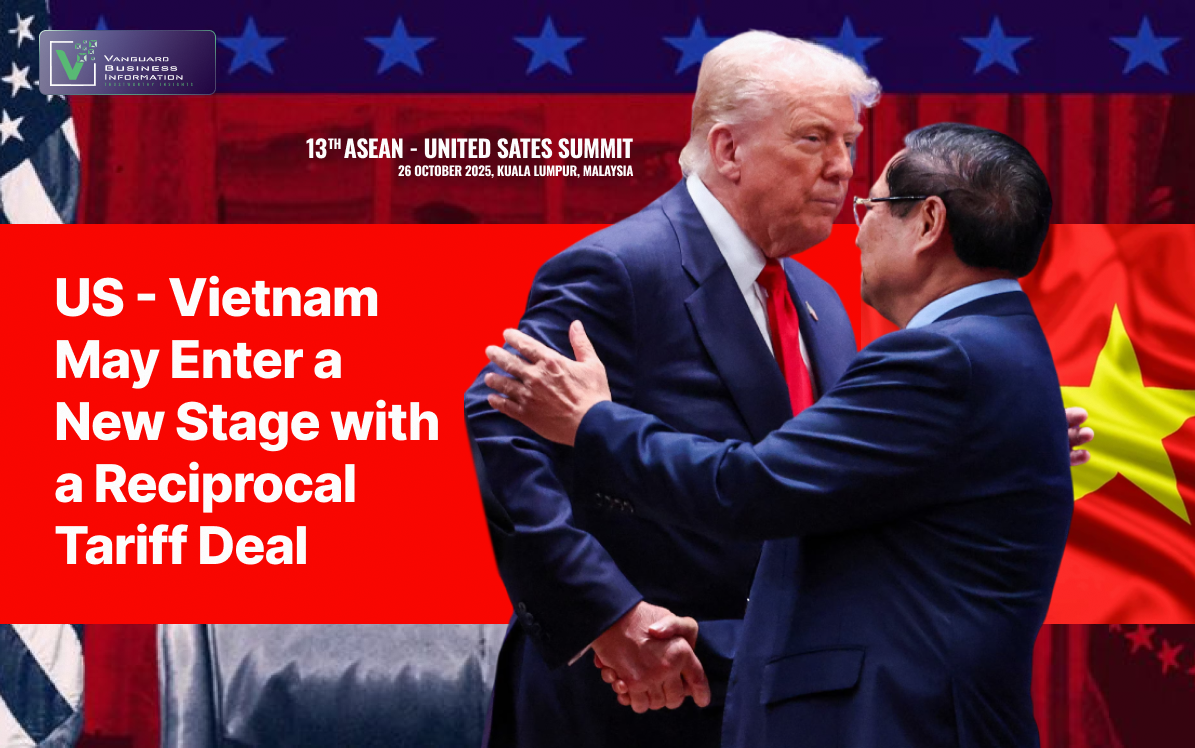
This development follows the ASEAN Summit (October 26–28) in Kuala Lumpur, Malaysia, where U.S. President Donald Trump and Vietnamese Prime Minister Pham Minh Chinh had a brief but significant meeting on the sidelines of the event.
A Short Meeting Between the Two Leaders
According to Vietnam’s Ministry of Foreign Affairs, Prime Minister Pham Minh Chinh had a short meeting with President Donald Trump during the 47th ASEAN Summit in Kuala Lumpur.
During the exchange, the Prime Minister conveyed an official invitation from General Secretary To Lam and other senior Vietnamese leaders for President Trump to visit Vietnam.
President Trump welcomed the invitation, expressing his interest and intention to arrange a suitable time for the visit.
Prime Minister Pham Minh Chinh also proposed that the U.S. coordinate a visit to Washington by General Secretary To Lam, to which President Trump responded positively, suggesting that Vietnam notify the U.S. in advance and also express his hope to welcome Prime Minister Pham Minh Chinh to the U.S. at an appropriate time.
Although brief, this meeting sent a clear diplomatic signal of the two sides’ willingness to maintain high-level dialogue amid complex trade negotiations.
The Relationship at a Possible Turning Point
The proposed agreement extends the foundation established by the U.S.–Vietnam Bilateral Trade Agreement signed in 2000 and effective since 2001. It facilitated Vietnam’s rapid integration into global value chains and helped make the U.S. its largest export market.
According to a White House statement on October 26, the framework aims to ensure reciprocal, fair, and balanced trade between the two nations.
“In the coming weeks, the United States and Vietnam will work to finalize the Reciprocal, Fair, and Balanced Trade Agreement, prepare the agreement for signing, and carry out domestic procedures before the agreement officially enters into force,” the statement said.
While the language signals political will, it does not guarantee the deal’s swift or smooth completion.
Reciprocal Tariffs and Market Access
Under the current framework, the U.S. would maintain a 20% reciprocal tariff on most Vietnamese products, as defined in Executive Order No. 14257 (April 2, 2025). Certain products listed in Annex III of Executive Order No. 14356 (September 5, 2025) could qualify for a 0% tariff, potentially easing pressure on selected Vietnamese exporters.
Meanwhile, Vietnam would grant preferential market access to nearly all U.S. agricultural and industrial goods. This includes accepting U.S. safety and emissions standards for automobiles, simplifying regulatory processes for pharmaceuticals, and removing import licensing barriers for American medical equipment.
Both sides have also expressed their intention to address non-tariff barriers and enhance cooperation on digital trade, investment, and structural reforms involving state-owned enterprises, customs, labor, and environmental standards.
However, these commitments remain subject to further negotiation and approval, leaving room for changes in scope and timing.
Agricultural and Supply Chain Concerns
Agriculture is expected to feature prominently in the agreement. Vietnam has indicated its willingness to recognize U.S. regulatory inspections and certifications, which could simplify the entry of American agricultural products into the Vietnamese market.
Both sides also signaled an intention to strengthen supply chain resilience, improve coordination on export controls, and address tax evasion.
Still, experts note that such ambitions could face challenges in implementation, particularly if global economic conditions shift or political priorities change.
Vietnam Faces Tariff Headwinds
Despite the promise of a future agreement, Vietnam is currently experiencing the immediate impact of U.S. tariffs.
A UNDP report released last month identified Vietnam as the most affected country in Southeast Asia by the recent U.S. tariff measures. Since the 20% tariff took effect on August 7, 2025, Vietnam’s exports to the U.S. have declined by 2% in August compared to July. Footwear exports, a key sector, fell by 5.5%, according to Vietnam Customs.
Philip Schellekens, UNDP’s Chief Economist for Asia-Pacific, warned that in a high-inflation scenario, the tariff could result in a gradual drop of more than USD 25 billion, or nearly one-fifth of Vietnam’s annual export value to the U.S.
In 2024, Vietnam’s exports to the U.S. reached USD 136.5 billion, making it the sixth-largest exporter to the American market. The trade surplus between the two countries stood at USD 123 billion.
IP, Labor and Regulatory Cooperation
The proposed agreement also includes provisions on intellectual property (IP) protection, labor standards, environmental commitments, and regulatory transparency — areas that have historically been complex in bilateral negotiations.
Vietnam has pledged to implement international IP treaties more fully, which could increase investor confidence and encourage technology transfer. For the U.S., these measures are designed to ensure a fairer competitive environment for American businesses.
Nonetheless, how and when these commitments will be enforced remains to be seen, especially given the often lengthy and sensitive nature of regulatory reforms.
Early Signals from the Private Sector
In parallel with government negotiations, private sector activity has continued to build momentum.
- Vietnam Airlines signed a contract with Boeing to purchase 50 aircraft valued at over USD 8 billion.
- Vietnamese enterprises signed 20 memoranda of understanding with U.S. companies to buy American agricultural products worth more than USD 2.9 billion.
These commercial agreements suggest strong underlying economic interests, even as the broader trade framework remains under discussion.
Strategic Cooperation Beyond Tariffs
As President Trump continues his Southeast Asia tour, the ongoing talks with Vietnam may signal a shift in trade dynamics, rather than a finalized outcome.
For Washington, Vietnam represents both a key trading partner and a strategic supply chain hub in industries such as electronics, textiles, and agriculture. For Hanoi, securing a stable, rules-based economic relationship with the U.S. is critical to sustaining export growth and attracting foreign investment.
However, the road to a formal agreement remains uncertain, and any deal could be subject to further revisions, delays, or political shifts.
If successfully concluded, the Reciprocal, Fair, and Balanced Trade Agreement could create a more structured framework for bilateral trade, balancing protectionist measures with new opportunities for cooperation.