

Published Sep 2025
Vietnam 2024: Between Economic Resilience and Political Stagnation
Vietnam's economy surged ahead in 2022 with one of the world’s highest growth rates, yet its political landscape remains tightly controlled by the Communist Party. The BTI 2024 Country Report reveals a stark contrast between economic resilience and democratic stagnation. This in-depth analysis highlights Vietnam’s governance challenges, human rights concerns, and future development trajectory.
Introducing the BTI 2024 Country Report on Vietnam
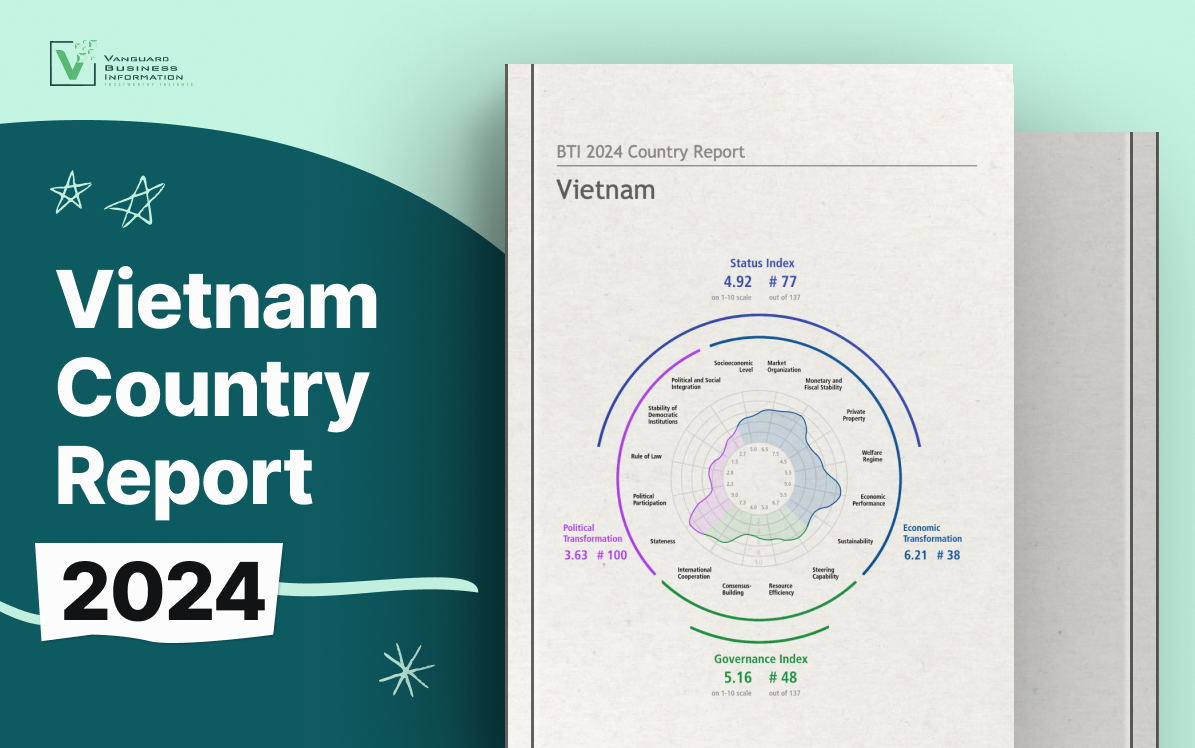
The BTI 2024 Country Report — Vietnam, published by the Bertelsmann Stiftung, provides a comprehensive assessment of Vietnam’s political transformation, economic development, and governance quality between February 2021 and January 2023. As part of the Transformation Index BTI, which evaluates 137 countries, this report ranks Vietnam within a global framework of authoritarian regimes and transitional economies.
Despite global disruptions, Vietnam’s economy in 2022 surged by 8.02%, positioning the country among the fastest-growing post-pandemic economies. However, this economic performance contrasts sharply with the nation's poor democratic credentials, entrenched corruption, and ongoing suppression of civil liberties.
Political Transformation: Authoritarian Rule and Internal Cleansing
One-Party Monopoly and Limited Civic Freedom
Vietnam remains a one-party communist state, dominated by the Communist Party of Vietnam (CPV). The report highlights a significant lack of political pluralism, with elections, press freedom, freedom of expression, and judicial independence scoring as low as 2 out of 10.
A notable feature of this period was the intensified anti-corruption campaign, led by CPV Secretary-General Nguyen Phu Trong. While lauded for targeting high-level corruption—leading to the resignation of two deputy prime ministers and the state president—the campaign also functioned as a political purge, consolidating Trong’s influence within the party hierarchy.
Human Rights Under Pressure
The report exposes increased state surveillance, harassment of activists, and digital repression under Vietnam’s cybersecurity law, enacted in 2019. Prominent environmental and civil society figures were arrested in 2022, while legal reform for association rights and public assembly remains stalled.
Economic Performance: Resilient Growth and Foreign Investment
Recovery After COVID-19
Vietnam's economic indicators are robust:
-
GDP Growth (2022): 8.02%
-
Foreign Direct Investment (FDI, 2022): $27.72 billion
-
Poverty Rate (2020): 3.8% (down from 14% in 2010)
-
Public Debt: 35.3% of GDP
Vietnam's post-pandemic rebound was fueled by export-oriented manufacturing, foreign capital inflows, and the resilience of the private sector, although thousands of small businesses were wiped out by the economic downturn.
Structural Challenges
Despite progress, the report identifies deep structural flaws, such as:
-
Continued favoritism toward state-owned enterprises (SOEs)
-
Political interference in the banking system
-
Unstable land tenure and widespread land disputes
-
A high degree of inequality, especially among ethnic minorities, women, and people with disabilities
Governance and Civil Society: Control Over Reform
The BTI 2024 report finds that although Vietnam has adopted multiple free trade agreements, such as the CPTPP and RCEP, and improved its international standing, its domestic governance remains deeply flawed.
Key governance scores:
-
Rule of Law: 2/10
-
Independent Judiciary: 2/10
-
Democratic Institutions Performance: 1/10
-
Association and Assembly Rights: 3/10
The party’s control over the judiciary, media, and civil society has not lessened, and despite rhetoric on “grassroots democracy,” implementation remains superficial.
Environmental and Social Policy: Progress and Repression
Vietnam has made strong climate commitments, including a net-zero emissions pledge by 2050, yet enforcement remains inconsistent. Environmental activists continue to face state suppression, and the expansion of hydropower has led to deforestation and flooding.
In education, Vietnam ranks impressively within ASEAN, with high literacy and school enrollment rates. However, the gender wage gap and discrimination against marginalized groups persist.
Download the Full Report
The full BTI 2024 Vietnam Country Report provides extensive data and analysis across 12 dimensions of transformation, from economic competitiveness to democratic accountability. It is essential reading for:
-
Investors seeking in-depth understanding of political risks
-
Policy analysts and researchers tracking Vietnam's development
-
Human rights advocates monitoring civil liberties in Southeast Asia
Download the full report on VNBIS.com or contact us for customized Vietnam country insights, company reports, and risk assessments.