Published Mar 2026
Vietnam Rice Exports in Early 2026
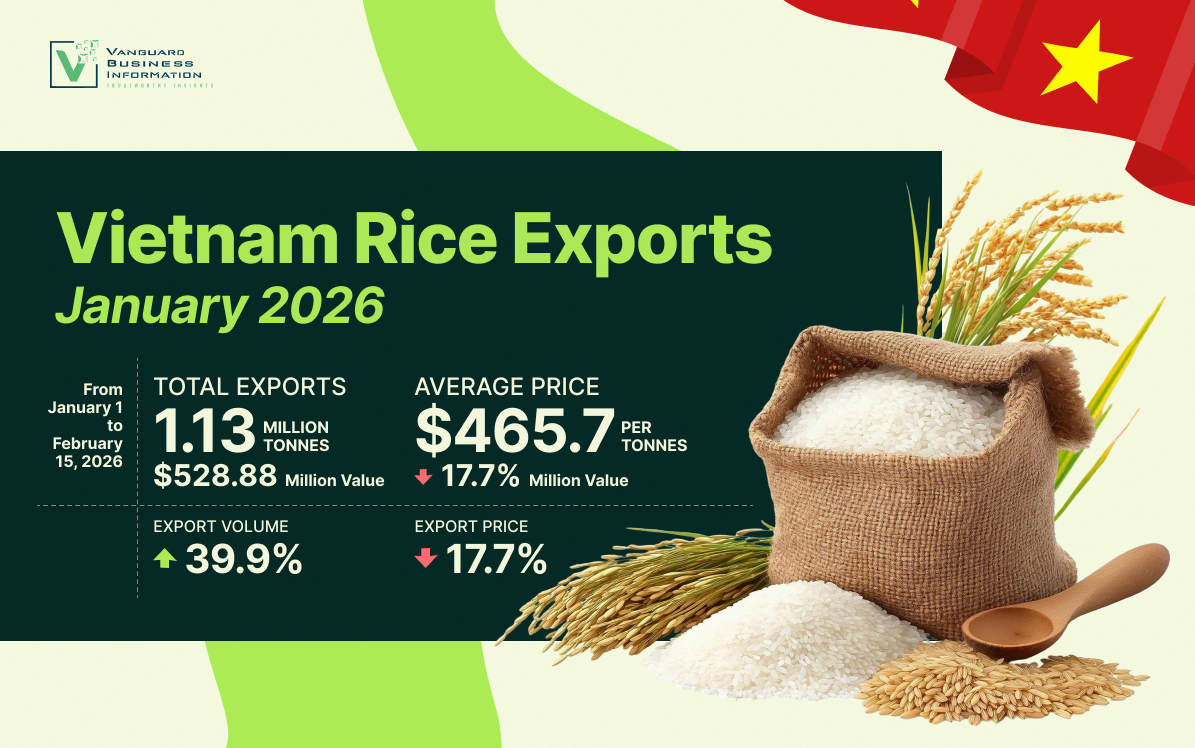
Vietnam’s rice exports surged in early 2026, with January shipments reaching 651,400 tonnes and total exports in the first 45 days hitting 1.13 million tonnes. While export volume jumped nearly 40% year on year, average prices fell sharply by 17.7% amid a global supply surplus led by India. With the Philippines and China accounting for almost 70% of total exports, Vietnam faces both strong demand momentum and rising competitive pressure in an increasingly complex global rice market.
Strong Volume Growth Amid Global Price Pressures
Vietnam's rice export sector started 2026 strongly, with total exports in the first 45 days reaching 1.13 million tonnes valued at USD 528.88 million, a 39.9% increase in volume compared to the previous year. Although the volume growth is impressive, average export prices have dropped sharply by 17.7% to USD 465.7 per tonne, due to a global supply surplus caused by record harvests in India and other Asian exporters. In January 2026, the Philippines and China together accounted for nearly 70% of Vietnam's rice exports, highlighting the need for market diversification.
1. Vietnam Rice Export Performance: January – Mid-February 2026
1.1 Cumulative Export Figures
According to Vanguard Business Information LLC, citing the Vietnam Customs Department, from January 1 to February 15, 2026, Vietnam exported a total of 1.13 million tonnes of rice valued at USD 528.88 million. This represents a year-on-year increase of 39.9% in volume and 15.1% in value — a robust opening to 2026 despite a challenging global pricing environment.
Within this period, the first 15 days of February 2026 alone saw 484,260 tonnes exported worth USD 218.98 million, indicating sustained export momentum heading into the peak harvest season.
1.2 January 2026 Breakdown
For January 2026 specifically, Vietnam exported 651,400 tonnes of rice of all varieties, valued at USD 309.9 million. Compared to December 2025, this represents a 24.7% increase in volume and a 24.6% increase in value. Year-on-year, volumes rose 19%, although export value edged down 4.6% due to lower average prices.
The average export price for January–February 2026 stood at USD 465.7 per tonne, down 17.7% from the same period in 2025, directly reflecting the global trend of falling rice prices driven by supply surpluses.
1.3 Domestic Production Update
As of February 24, 2026, provinces and cities in the Mekong River Delta had successfully planted 1.266 million hectares of rice for the 2025–2026 Winter-Spring crop, achieving 100% of the planned area. Harvest activities were underway, with approximately 250,000 tonnes already collected at a yield of 66.16 quintals per hectare, and total estimated output projected at 1.654 million tonnes of paddy — providing a solid foundation for continued export activity.
2. Key Export Markets: January 2026
Vietnam exported rice to over 20 markets in January 2026. The Philippines and China dominated, jointly representing close to 69% of total export volume. Below is a detailed breakdown of Vietnam's top export destinations:
|
Market |
Volume (tonnes) |
Avg. Price (USD/t) |
Value (USD '000) |
Share (%) |
|
Philippines |
331,770 |
444.4 |
147,453 |
50.9% |
|
China |
118,189 |
480.5 |
56,793 |
18.1% |
|
Ghana |
52,654 |
524.6 |
27,620 |
8.1% |
|
Malaysia |
47,738 |
408.7 |
19,512 |
7.3% |
|
Côte d'Ivoire |
11,029 |
421.2 |
4,645 |
1.7% |
|
Mozambique |
9,305 |
576.9 |
5,368 |
1.4% |
|
Singapore |
8,642 |
554.4 |
4,791 |
1.3% |
|
Hong Kong |
5,575 |
589.4 |
3,286 |
0.9% |
|
Saudi Arabia |
5,367 |
578.2 |
3,103 |
0.8% |
|
UAE |
5,287 |
611.2 |
3,232 |
0.8% |
|
Cambodia |
2,514 |
572.0 |
1,438 |
0.4% |
|
Australia |
2,722 |
740.5 |
2,016 |
0.4% |
|
USA |
2,830 |
736.1 |
2,083 |
0.4% |
|
Others |
43,308 |
— |
14,066 |
6.6% |
|
TOTAL |
651,430 |
475.7 |
309,896 |
100% |
Source: Vietnam Customs Department (preliminary data)
2.1 Philippines — Dominant Market
The Philippines remained Vietnam's single largest rice export market in January 2026, absorbing 331,770 tonnes (50.9% of total volume) valued at USD 147.45 million. This was a 48% year-on-year surge in volume, though the average price declined 20.6% to USD 444.4 per tonne. While the Philippines continues to be a cornerstone market, its government has announced plans to cap monthly rice imports at 150,000 tonnes during the March–April 2026 harvest season, down sharply from the usual 400,000 tonnes per month, to protect local farmers.
2.2 China — High-Growth Market
China was the standout performer in January 2026, with Vietnam exporting 118,189 tonnes valued at USD 56.79 million — an extraordinary 551.9% surge in volume compared to January 2025. This sharp rebound from previous low levels positions China as a key growth driver for Vietnam's rice exports in the near term, though the sustainability of this momentum remains to be monitored.
2.3 Ghana and Malaysia — Stable African and ASEAN Markets
Ghana ranked third with 52,654 tonnes (USD 27.62 million), though volumes fell 11.3% year-on-year amid declining average prices. Malaysia absorbed 47,738 tonnes (USD 19.51 million), with volume up a substantial 217.2% compared to January 2025 — making it one of the fastest-growing traditional markets.
2.4 Markets Showing Decline
Several previously strong markets posted significant declines in January 2026. Exports to Côte d'Ivoire dropped 88.3% year-on-year to just 11,029 tonnes, while Singapore fell 29% and Indonesia decreased 77.9% in volume. Taiwan, Indonesia, Australia, and the Netherlands also recorded year-on-year contractions, reflecting high existing inventory levels in those markets.
3. Top 10 Vietnamese Rice Exporters — January 2026
The following companies led Vietnam's rice export performance in January 2026 by export value, according to preliminary customs data:
|
Rank |
Company Name |
Export Value (USD '000) |
|
1 |
32,663 |
|
|
2 |
29,623 |
|
|
3 |
20,525 |
|
|
4 |
15,675 |
|
|
5 |
13,614 |
|
|
6 |
12,527 |
|
|
7 |
11,439 |
|
|
8 |
10,469 |
|
|
9 |
10,313 |
|
|
10 |
10,246 |
Source: Vietnam Customs Department (preliminary data — for reference only)
Thanh Tin Trading and Services Co., Ltd. led all exporters with USD 32.66 million, followed by Mekong Food Joint Stock Company (USD 29.62 million) and Tay Ninh Sugar Joint Stock Company (USD 20.53 million). The top 10 companies collectively generated approximately USD 183 million, representing around 59% of total January 2026 rice export value, indicating a moderately concentrated but competitive export landscape.
4. Global Rice Market Context
4.1 Record Global Supply Surplus
Global rice prices entered 2026 at subdued levels, with the USDA projecting worldwide production to reach a record 541 million tonnes in the 2025/26 crop year against demand of just 538.6 million tonnes. This marks the third consecutive year of global supply surplus, keeping prices under pressure. End-of-year inventories are expected to remain elevated at approximately 191 million tonnes, concentrated primarily in China and India.
4.2 India's Growing Dominance
India surpassed China as the world's leading rice producer beginning in the 2024/25 crop year, and is on track for another record harvest in 2025/26, supported by record Kharif crop yields and increased Rabi planting area. India's rising surplus export volumes are increasingly reshaping global rice market dynamics — a structural shift that places sustained downward pressure on international prices and directly challenges Vietnamese exporters' competitiveness and margins.
4.3 Thailand's Export Challenges
Vietnam's main regional competitor, Thailand, saw its rice exports fall sharply in January 2026, down 17.5% in volume and 30.7% in value year-on-year, as a stronger Baht and abundant global supply weighed on competitiveness. The Thai Rice Exporters Association has set a 2026 export target of just 7.03 million tonnes, down 11% from the previous year and the lowest target in five years since 2021.
4.4 Philippines Import Policy Tightening
The Philippine government is actively managing rice import flows to protect its domestic farming sector. Import quotas were cut to approximately 150,000 tonnes per month in March–April 2026, less than 40% of the usual monthly volume. While this is a temporary, harvest-season measure, it signals a policy trend toward greater protectionism that Vietnamese exporters must anticipate and adapt to over the medium term.
5. Opportunities for Vietnam's Rice Exports in 2026
- Strong demand from China: The exceptional 551.9% year-on-year volume surge in January 2026 suggests renewed Chinese purchasing appetite. If sustained, China could become a consistently top-tier market for Vietnamese rice, particularly for fragrant and specialty varieties.
- Record global trade volumes: The USDA forecasts global rice trade to reach a record 62.8 million tonnes in 2026, creating opportunities for Vietnam to capture a larger share of incremental demand, especially in Africa, the Middle East, and Southeast Asia.
- Favorable crop conditions: With the 2025–2026 Winter-Spring crop on track at 100% of planned planting area and strong projected yields in the Mekong Delta, Vietnam has ample supply to meet export commitments in the first half of 2026.
- Market diversification: Emerging or recovering markets such as Malaysia (+217.2%), Saudi Arabia (+159%), and Russia (+88.3%) offer growth potential and reduce dependency on any single buyer.
- Premium rice positioning: Vietnam's gradual shift toward high-value fragrant rice varieties (ST25, Jasmine, etc.) offers a pathway to protect revenue even as average prices fall — countries like the USA (USD 736/tonne), Australia (USD 740/tonne), and Netherlands (USD 833/tonne) pay significantly higher prices for premium grades.
6. Challenges and Risks for 2026 and Beyond
- Global price pressure: Persistently high global inventories and record production from India are structural headwinds that will keep export prices under sustained downward pressure. Vietnam's average rice export price has already fallen 17.7% year-on-year as of February 2026.
- Thin contract pipeline: Businesses report that new contract volumes are below historical norms due to elevated inventory levels in key importing countries. Buyers are purchasing in smaller, more fragmented batches, reducing revenue predictability for Vietnamese exporters.
- Philippine import restrictions: As Vietnam's largest single market, any policy tightening by the Philippines — such as the current harvest-season import cap of 150,000 tonnes/month — has a disproportionate impact on overall Vietnamese export volumes.
- Intensifying competition: India's growing role as a decisive market-shaping force, combined with competitive pricing from Myanmar, Pakistan, and other exporters, is squeezing Vietnam's traditional price advantage in bulk rice segments.
- Exchange rate risks: A strengthening USD versus the Vietnamese Dong may provide some competitive pricing benefit, but adverse movements in importing countries' currencies (as seen in Thailand's Baht-driven export decline) could dampen demand.
- Climate and supply variability: While current crop conditions are favorable, Vietnam's Mekong Delta rice production remains vulnerable to climate shocks such as drought, salinity intrusion, and flooding — risks that could disrupt export supply at short notice.
7. Outlook and Strategic Recommendations
Vietnam's rice export sector has started 2026 on a positive note, driven primarily by volume growth in its key markets. However, the underlying price environment is challenging, and exporters face a more complex operating landscape than in recent years. To sustain competitiveness and revenue growth, the following strategic priorities are recommended:
- Accelerate premium rice branding: Expand the presence of Vietnamese fragrant and specialty rice in high-value markets (USA, Europe, Japan, South Korea) where price premiums of USD 200–400/tonne above commodity prices are achievable.
- Diversify market base: Reduce over-reliance on the Philippines (currently 50.9% of volume) by systematically developing markets in Africa, the Middle East, and South Asia where demand growth is strongest.
- Invest in logistics and post-harvest infrastructure: Reducing post-harvest losses and improving grain quality consistency will be critical to maintaining competitiveness against Indian and Thai exporters.
- Engage in trade diplomacy: Proactive government-to-government engagement with key importing nations — particularly the Philippines, Indonesia, and African states — can help secure long-term import commitments and favorable tariff conditions.
- Monitor and respond to Philippines import policy: Given the Philippines' structural importance to Vietnam's rice trade, exporters should closely track Manila's import regulatory environment and build relationships with private sector importers who can act swiftly when import windows open.