Published Jan 2026
Vietnam Rubber Exports in 2025: High Prices Sustain Export Value Despite Volume Decline
Vietnam’s rubber exports in 2025 faced declining volumes amid slowing global demand, yet export turnover remained resilient thanks to sustained high prices. This article analyzes export performance, China’s shifting import structure, key market trends, and profiles the top 20 rubber exporters shaping Vietnam’s rubber industry outlook.
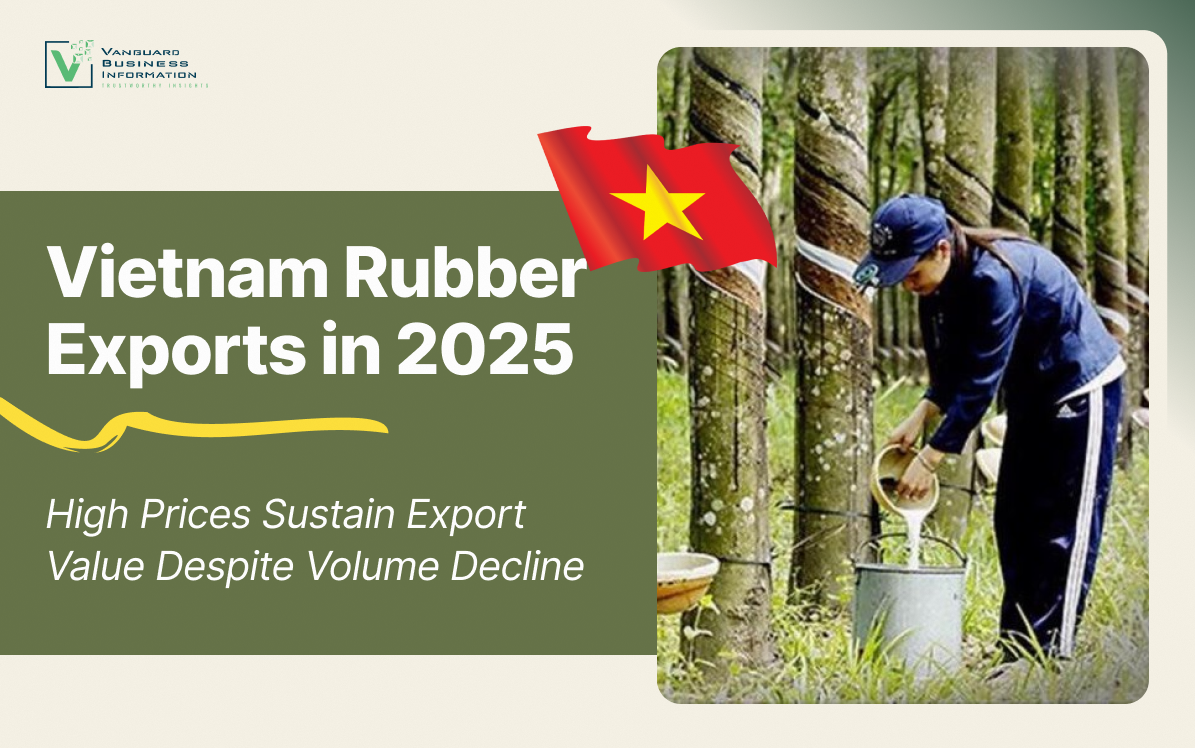
Vietnam’s rubber export sector in 2025 continued to face a complex global environment marked by slowing industrial demand, intensified competition, and heightened uncertainty in major consuming markets. Despite a notable contraction in export volume, Vietnam’s rubber export value remained relatively resilient, supported by sustained high prices throughout most of the year. As a result, total rubber export turnover in 2025 is estimated to exceed USD 3.2 billion, reinforcing the sector’s ongoing role in Vietnam’s agricultural and export economy.
Export Performance in Late 2025 and Full-Year Overview
Preliminary estimates indicate that Vietnam exported approximately 200 thousand tons of rubber in December 2025, generating export revenue of around USD 337 million. Compared with November, export volume and value increased modestly, reflecting short-term shipment recovery toward year-end. However, compared with December of the previous year, exports declined sharply in both volume and value, highlighting persistent structural challenges in global demand.
For the full year 2025, Vietnam’s rubber exports are estimated at about 1.86 million tons, with total export value reaching approximately USD 3.24 billion. While export volume declined by more than 7% compared with the previous year, export value fell by only around 5%, underscoring the cushioning effect of elevated export prices.
Price Trends Offset Volume Weakness
Customs data for the first 11 months of 2025 show that Vietnam exported approximately 1.66 million tons of rubber, valued at USD 2.91 billion. Compared with the same period of the previous year, export volume declined by over 6%, while export value decreased by less than 2%.
During this period, the average export price of Vietnamese rubber reached approximately USD 1,750 per ton, representing a solid year-on-year increase. This pricing trend helped stabilize export earnings despite weaker shipment volumes and has been analyzed in several market commentaries previously published on VNBIS.com focusing on Vietnam’s commodity price resilience.
China Remains the Core Market but with Rising Pressure
China continued to dominate Vietnam’s rubber export structure in 2025, accounting for more than 70% of total export volume during the first 11 months of the year. Exports to China reached approximately 1.21 million tons, with a total value exceeding USD 2.1 billion.
Although export volume to China declined slightly year on year, export value increased, driven by higher average prices. The average export price to China reached approximately USD 1,735 per ton, reflecting improved pricing but also intensifying competition from alternative suppliers. Related analysis on China-Vietnam commodity trade dynamics and supplier competition has been consistently covered in VNBIS.com’s China market outlook series.
China’s Rubber Import Structure and Competitive Landscape
China’s overall rubber imports continued to expand in 2025, driven by long-term industrial demand. However, the composition of suppliers shifted notably. Thailand strengthened its position as China’s largest rubber supplier, increasing both volume and market share. Russia and Côte d’Ivoire also recorded strong growth in shipments to China.
Vietnam remained China’s second-largest supplier by volume, but its market share declined compared with the previous year. While Vietnamese rubber maintained a price advantage over some competitors, it remained less competitive than premium suppliers in terms of pricing. This trend reflects broader structural challenges discussed in VNBIS.com’s regional rubber supply chain assessments.
Automotive Slowdown Weighs on Rubber Demand
China’s rubber consumption is closely linked to the automobile and tire manufacturing industries. According to data from the China Passenger Car Association, passenger vehicle sales in China declined notably toward the end of 2025, marking consecutive months of contraction.
At the same time, inventory levels at automobile dealerships rose significantly, signaling slowing end-user demand. This weakening automotive outlook is expected to continue exerting downward pressure on rubber consumption in the near term and remains a key risk factor for Vietnam’s rubber exports, as highlighted in VNBIS.com’s sector risk briefings.
Market Diversification: Gains and Limitations
Beyond China, Vietnam’s rubber exports showed mixed performance across global markets. Exports to Malaysia, Indonesia, Türkiye, Pakistan, and several Latin American markets recorded strong growth in both volume and value, indicating some success in diversification strategies.
In contrast, exports to India, the United States, Germany, Russia, Taiwan, and Sri Lanka declined in volume, reflecting softer industrial demand and ongoing trade adjustments in these markets. These contrasting trends underscore the uneven recovery of global rubber demand and reinforce the importance of diversified export strategies.
Top 20 Rubber Exporters by Turnover (First 11 Months of 2025)
Based on aggregated customs and enterprise data, the following companies emerged as Vietnam’s leading rubber exporters by export turnover during the first 11 months of 2025:
|
No. |
Company |
Turnover (USD ‘000) |
|
1 |
350,851 |
|
|
2 |
268,286 |
|
|
3 |
255,478 |
|
|
4 |
231,142 |
|
|
5 |
205,766 |
|
|
6 |
161,442 |
|
|
7 |
138,721 |
|
|
8 |
69,570 |
|
|
9 |
60,687 |
|
|
10 |
52,928 |
|
|
11 |
Viet Phu Thinh Rubber Joint Stock Company |
51,138 |
|
12 |
45,112 |
|
|
13 |
44,528 |
|
|
14 |
43,511 |
|
|
15 |
41,541 |
|
|
16 |
37,100 |
|
|
17 |
36,723 |
|
|
18 |
Mai Vinh Rubber Production & Trading Service One Member Co., Ltd |
34,694 |
|
19 |
32,170 |
|
|
20 |
31,833 |
These exporters account for a substantial share of Vietnam’s total rubber export value and continue to shape the country’s competitive position in global markets. Several of these companies have been profiled in depth in company-level analyses previously published on VNBIS.com.
Outlook for 2026: Value Stability Amid Structural Risks
Looking ahead, the global rubber market in 2026 is expected to remain challenging. According to forecasts by the Association of Natural Rubber Producing Countries, global rubber consumption growth is slowing amid economic uncertainty and weaker manufacturing demand.
China will remain the single most influential market for Vietnam’s rubber exports, but competition, supply diversification, and demand uncertainty will continue to constrain volume growth. Nevertheless, if rubber prices remain at relatively elevated levels, Vietnam’s rubber export turnover is likely to remain stable, even under continued volume pressure.
Overall, Vietnam’s rubber sector in 2025 demonstrates a clear transition from volume-driven growth toward price-supported value retention. How effectively exporters adapt to shifting demand patterns and competitive dynamics will be critical to sustaining performance in the years ahead.