Published Jan 2026
Vietnam: Top 10 Animal Feed Companies and Uncomfortable Truth
Vietnam’s animal feed market is worth tens of trillions of dong, but behind the Top 10 companies lies an uncomfortable truth: foreign groups dominate not only feed production, but also the raw-material choke points that quietly decide prices, margins, and who survives the next cycle.
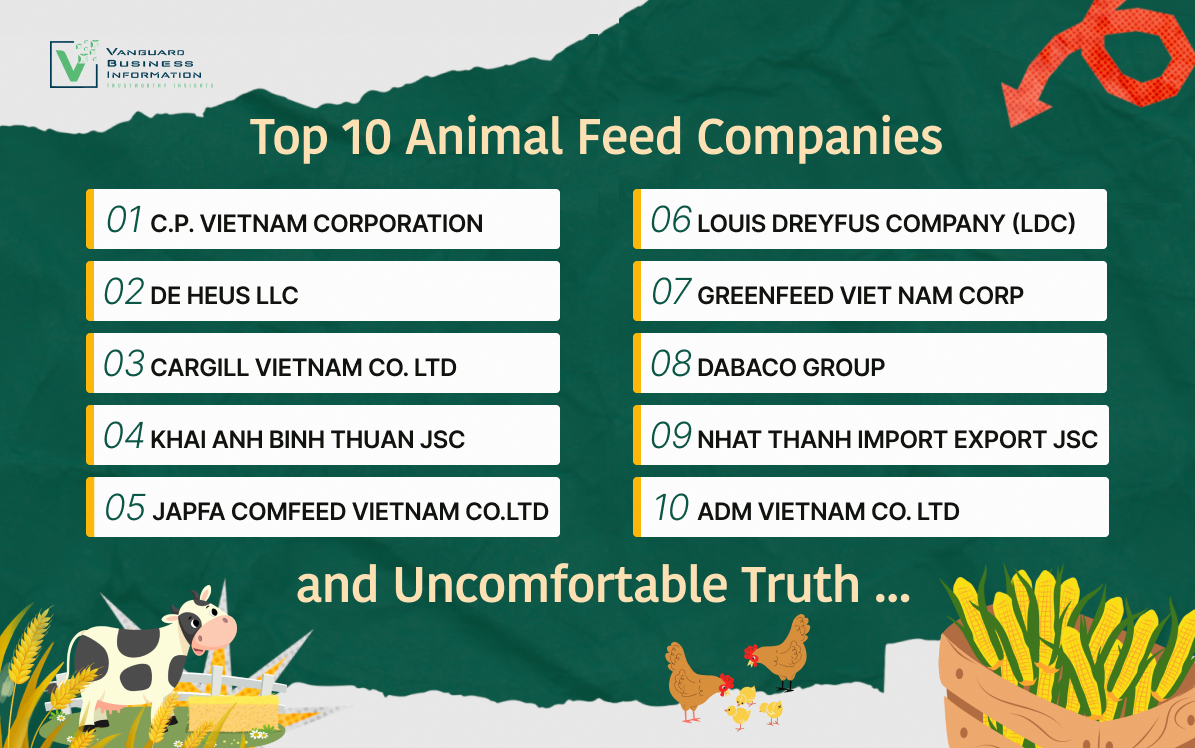
NO.1 C.P. VIETNAM CORPORATION — ~VND 90.19 tn
C.P. Vietnam operates on a different scale than the rest of the market. Established in 1996 with FDI status, CP’s advantage extends beyond feed, it encompasses the integrated “3F Plus” model (feed–farm–food), which enables control over volume, logistics, and downstream demand. According to VNBIS, CP is recognized as a major player in agro-food with total sales of USD 3.23 billion (latest data), though profits have declined sharply, a reminder that even large companies face livestock cycle and input cost fluctuations. CP also shows recorded “bad news” flags on VNBIS—something commercial partners should review before offering large credit lines.
NO.2 DE HEUS LLC — ~VND 33.40 tn
De Heus is one of the most essential foreign-owned feed producers in Vietnam, positioned strongly in both livestock and aquaculture feed. VNBIS notes it was established in 2008, operates as a one-member LLC, and is 100% owned by De Heus Animal Nutrition B.V. (Netherlands). What stands out is the combination of scale (VNBIS shows ~USD 1.09bn sales and ~USD 954m assets for the latest year displayed) and the warning sign: a reported net loss despite revenue growth. That mix (significant volume, pressured profitability) often signals margin compression due to raw material costs, pricing competition, or aggressive capacity expansion.
NO.3 CARGILL VIETNAM COMPANY LIMITED — ~VND 32.09 tn
Cargill is a classic example of how global supply-chain power translates into feed competitiveness. VNBIS shows that Cargill Vietnam was established in 1995, is wholly owned by Cargill Asia Pacific Holdings PTE LTD, and is deeply embedded in the “manufacture of feeds for cattle, poultry, and aquatic animals.” It also lists a broad footprint of facilities/branches across multiple provinces—an operational strength when serving large integrators and regional farm clusters. The strategic edge is procurement and formulation know-how; the strategic risk is that Vietnam’s feed market is susceptible to global grain volatility and domestic disease cycles—both can whipsaw demand and working capital.
NO.4 KHAI ANH BINH THUAN JOINT STOCK COMPANY — ~VND 31.85 tn
This is the most “surprising” name in your Top 10 because it is newer (registered 2019) yet already huge by sales volume—driven by the role it plays in agricultural raw materials trading (soybean meal, corn kernels, cassava, coconut meal—core feed inputs). VNBIS highlights total sales of USD 1.41bn and assets of USD 339.54m (latest shown), with strong YoY growth. In the feed ecosystem, companies like this can indirectly influence the market: when they scale import/distribution well, they can reshape input availability and pricing for feed mills. VNBIS also flags a meaningful number of “bad news” items—partners should treat that as a due diligence trigger, not a footnote.
NO.5 JAPFA COMFEED VIETNAM LIMITED COMPANY — ~VND 22.15 tn
Japfa’s competitive model is similar to CP’s in spirit: a feed business anchored by integrated livestock operations and distribution reach. VNBIS lists Japfa Vietnam as FDI, established in 2007, wholly owned by Japfa Vietnam Investments Pte Ltd (Singapore), and shows sales rising to USD 805.81m with assets ~USD 557.52m (latest shown). The key point is not only scale—it’s steady demand supported by Japfa’s own downstream activities. The concern is also apparent in VNBIS: despite sales growth, Japfa “continued to face financial difficulties,” which in practice often means higher finance costs, margin pressure, or expansion risks.
NO.6 LOUIS DREYFUS COMPANY VIET NAM TRADING AND PROCESSING CO., LTD — ~VND 21.02 tn
LDC is not a feed mill brand in the consumer sense—it is a global agricultural merchant and processor. Its relevance to Vietnam feed is direct: LDC’s Vietnam operations include importing/merchandising/distribution to local agro-industrial players, “mostly within the animal feed sector” (LDC’s own Vietnam description). In other words, LDC can be a high-impact upstream supplier in the feed chain, especially when global logistics tighten or commodity spreads widen.
NO.7 GREENFEED VIET NAM CORPORATION — ~VND 19.30 tn
Greenfeed is one of the strongest “Vietnam-rooted” operators on your list. Still, VNBIS shows it is partially foreign-owned (notably 63.02% held by Oriental Ford Holding Limited (China), plus a smaller stake in Thailand). Operationally, Greenfeed sits in the high-value zone: feed, farming, and food processing. Financially, VNBIS shows USD 757.28m sales(latest shown), improving profitability (USD 40.26m net profit) and sharply higher equity YoY—an essential signal of balance-sheet strengthening even when sales growth is modest. That pattern often reflects margin discipline and better cost control, both of which matter in a commodity-sensitive industry.
NO.8 DABACO GROUP — ~VND 13.74 tn
Dabaco is the locally listed champion in this Top 10. VNBIS shows it was registered in 2004, ticker DBC, and describes a diversified agribusiness model spanning feed, breeding, slaughtering/processing, retail, and other segments. The headline number on VNBIS is the sharp profit rebound (net profit up massively YoY in the latest displayed year), alongside sales growth. Dabaco’s story matters for Vietnam’s feed market because it demonstrates that domestic groups can compete when they build vertical integration and distribution muscle—but they remain exposed to the same structural risks: disease cycles, input prices, and consumer demand.
NO.9 NHAT THANH IMPORT EXPORT JOINT STOCK COMPANY — ~VND 12.61 tn
Nhat Thanh is another “feed-power” company that wins through inputs rather than branded feed bags. VNBIS describes it as an agricultural trading firm focused on commodities such as rice, corn, and soybean meal—the oxygen of the feed industry. VNBIS also provides precise financial detail: sales ~USD 364.88m, assets down YoY, and profit extremely thin (~USD 78k)—a profile that screams “high volume, razor margins.” That’s not necessarily bad, but it changes how partners should structure credit terms, collateral, and payment monitoring.
NO.10 ARCHER DANIELS MIDLAND VIETNAM COMPANY LIMITED — ~VND 12.36 tn
ADM is another upstream heavyweight. Globally, ADM positions itself as a leader in human and animal nutrition; locally, its presence in Vietnam is often linked to sourcing, trading, distribution, and ingredient solutions that feed mills depend on. For Vietnam’s feed sector, ADM’s influence typically shows up in supply security, specification consistency, and risk management in procurement especially when commodity markets swing.
The uncomfortable truths
International companies dominate the commanding heights of Vietnam’s feed ecosystem, not only via feed manufacturing (CP, De Heus, Cargill, Japfa) but also via control of upstream ingredients and trade flows (LDC, ADM, and large import/distribution players). That structure matters because it means Vietnam’s feed pricing and availability can be influenced by global procurement, FX, freight rates, and geopolitical shocks, sometimes more than by domestic farm demand.
At the same time, the dataset also shows a second truth: Vietnam’s feed industry is not “just feed companies.” Several top names are powerful because they sit at raw-material chokepoints (soybean meal, corn, cassava, by-products). When these players expand quickly (as seen with newer, fast-scaling traders), they can reshape margins across the entire chain, from feed mills to farms.
Finally, scale does not equal safety. VNBIS profiles repeatedly show that even billion-dollar operators can face profit compression, and many companies have “adverse news” signals that should trigger deeper checks before extending credit, signing long-term contracts, or relying on a single supplier.
Why VNBIS matters here
For investors, suppliers, banks, and counterparties working with feed manufacturers and input traders, Vanguard Business Information on VNBIS.com is designed to reduce blind spots: legal status, ownership (FDI vs local), networks of related entities, financial performance, and risk signals, so decisions aren’t made on brand reputation alone.