Published Dec 2025
Vietnam’s Socio-Economic Performance in Nov 2025
Vietnam’s economic performance in November and the first eleven months of 2025 highlights a resilient and increasingly capital-intensive growth trajectory. Based on official data from the General Statistics Office of Vietnam and analysis by VNBIS, this article reviews developments across agriculture, industrial production, business registration, and investment, showing how manufacturing-led expansion and strong foreign capital inflows continue to support economic growth amid ongoing structural adjustment.
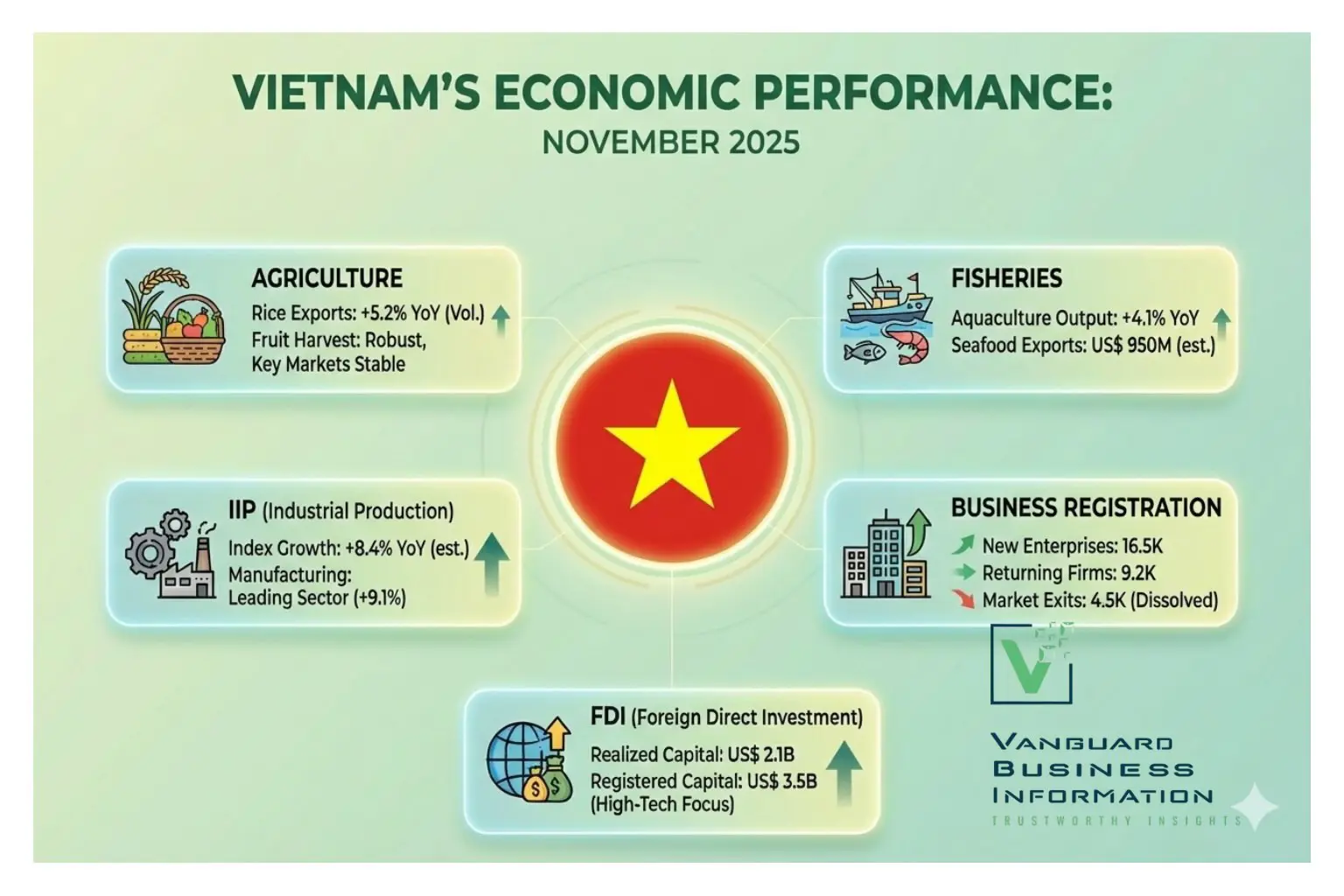
Agricultural Stability & Industrial Expansion
Vietnam’s economy in 2025 presents a picture of measured resilience and structural continuity. While global uncertainties, climate-related disruptions, and domestic cost pressures remain present, the country has sustained growth across key pillars of production, enterprise formation, and investment. According to the General Statistics Office of Vietnam (GSO), economic activity during November and the first eleven months of 2025 reflects not only cyclical recovery, but also more profound structural shifts toward manufacturing-led growth and capital-intensive development. This article reviews Vietnam’s performance across agriculture, industry, business registration, and investment, based on verified official data and analysis by Vanguard Business Information LLC (VNBIS).
Agriculture, Forestry, and Fisheries: Stability Under Environmental Pressure
Agriculture, forestry, and fisheries continued to provide a stabilizing foundation for Vietnam’s economy in 2025, despite notable challenges posed by adverse weather. In November, agricultural production focused on harvesting seasonal rice crops, winter planting, and recovery efforts following storms and floods, particularly in the South Central Coast and Central Highlands.
Rice production remained broadly stable. By November 20, 2025, Vietnam had harvested 1.28 million hectares of seasonal rice, equivalent to 83.3% of the planted area and broadly in line with the previous year. Average yields improved, with national productivity estimated at 52.4 quintals per hectare, higher than in 2024. Total seasonal rice output was estimated at 8.07 million tons, reflecting modest year-on-year growth.
In forestry, the newly planted forest area in November reached 29.9 thousand hectares, slightly lower than the previous year, while timber output increased to 2.48 million cubic meters, supported by stable raw material prices. Over the eleven months, timber harvesting rose 6.8%, confirming continued strength in wood-based supply chains. Notably, forest damage declined sharply, with the total area of forest affected falling by more than 30% year-on-year, signaling improved environmental control and enforcement.
Fisheries output continued to expand, driven by aquaculture. Total fishery production in November reached 904.5 thousand tons, up 2.6% year-on-year. Aquaculture output increased more strongly, supported by rising export demand and favorable prices, particularly for shrimp and pangasius. For the first eleven months of 2025, total fisheries production reached 9.05 million tons, up 2.9%, reinforcing the sector’s role as a reliable contributor to food security and exports.
Industrial Production: Manufacturing Remains the Core Growth Driver
Industrial activity emerged as one of the strongest pillars of Vietnam’s economy in 2025. GSO data show that the Industrial Production Index (IPI) rose by 10.8% year-on-year in November, while increasing 2.3% compared to October. Over the first eleven months of the year, IIP expanded by 9.3%, surpassing the growth recorded in the same period of 2024.
Manufacturing and processing remained the dominant engine of industrial expansion. Output in this sector rose 10.6%during the eleven months, contributing 8.5 percentage points to overall industrial growth. Electricity production and distribution increased 6.5%, while water supply and waste management rose 8.4%, reflecting rising industrial and urban demand. Mining activity returned to modest growth after previous contractions.
Several manufacturing subsectors recorded double-digit growth. Motor vehicle production increased 22.0%, non-metallic mineral products rose 16.5%, rubber and plastics 16.4%, basic metals 15.5%, and garments 13.5%. Electronics and optical products also grew steadily, confirming Vietnam’s continued integration into global manufacturing and export supply chains.
Industrial employment mirrored this expansion. As of early November 2025, employment in industrial enterprises increased 3.7% year-on-year, with foreign-invested firms recording the fastest growth. According to VNBIS, this trend highlights the central role of FDI-backed manufacturing in job creation and productivity gains.
Business Registration: High Turnover, Rising Capital Intensity
Vietnam’s enterprise landscape in 2025 reflected both dynamism and consolidation. In November, 15,100 new enterprises were established nationwide, with registered capital totaling VND 160.5 trillion. While this represented a decline from October, it marked a 34.9% increase year-on-year, indicating sustained entrepreneurial activity.
At the same time, 9,700 enterprises resumed operations, up 25.6% compared to November 2024, suggesting improving business confidence. However, market exits remained significant. In November alone, more than 4,800 enterprises temporarily suspended operations, while over 4,000 firms completed dissolution procedures, more than doubling year-on-year.
Cumulatively over the first eleven months of 2025, 275,600 enterprises were newly established or returned to operation, an increase of 26.1% year-on-year, averaging 25,100 enterprises per month. Meanwhile, 205,400 enterprises exited the market, underscoring intense competition and ongoing structural adjustment.
A key highlight was capital formation. Total additional registered capital reached VND 5.6 quadrillion, up 104.3% compared to 2024. According to VNBIS, this surge reflects a shift toward larger-scale enterprises and higher capital commitments, rather than growth driven purely by the number of new firms.
Investment: Strong Public Spending and Record FDI Execution
Investment activity remained robust throughout 2025. State budget investment disbursement reached VND 736.4 trillionover eleven months, equivalent to 72.2% of the annual plan and up 26.8% year-on-year. Accelerated public investment supported infrastructure development and regional economic connectivity.
Foreign direct investment continued to be a critical growth driver. Realized FDI reached USD 23.6 billion, up 8.9% year-on-year, representing the highest disbursement level for the period in five years. Manufacturing accounted for nearly 83% of realized FDI, reaffirming Vietnam’s role as a regional production hub.
Total registered foreign investment reached USD 33.69 billion, up 7.4%. Newly licensed projects numbered 3,695, with manufacturing and real estate attracting the largest share. Singapore remained the leading investor, followed by China, Hong Kong, Japan, and Sweden.
Conclusion: A Resilient Economy with Structural Depth
Vietnam’s economic performance in 2025 demonstrates resilience rooted in structural fundamentals. Agriculture and fisheries provided stability, industry—particularly manufacturing—drove growth, enterprise formation showed strong capital backing, and investment flows remained robust. While business turnover remains high, the data suggest a maturing economy characterized by consolidation, scale, and productivity-driven expansion.
From the perspective of VNBIS, Vietnam’s trajectory in 2025 is less about rapid numerical expansion and more about quality, capitalization, and integration into global value chains—a shift that will shape the country’s medium-term economic outlook.