Published Jan 2026
Vietnam’s Footwear Industry: Big Volumes, Thin Margins
Vietnam’s footwear industry stands at the center of global manufacturing, delivering massive export volumes to the US, EU, and beyond. But as costs rise and regulations tighten, the industry faces a fundamental question: can a manufacturing powerhouse remain competitive without capturing more value in the global supply chain?
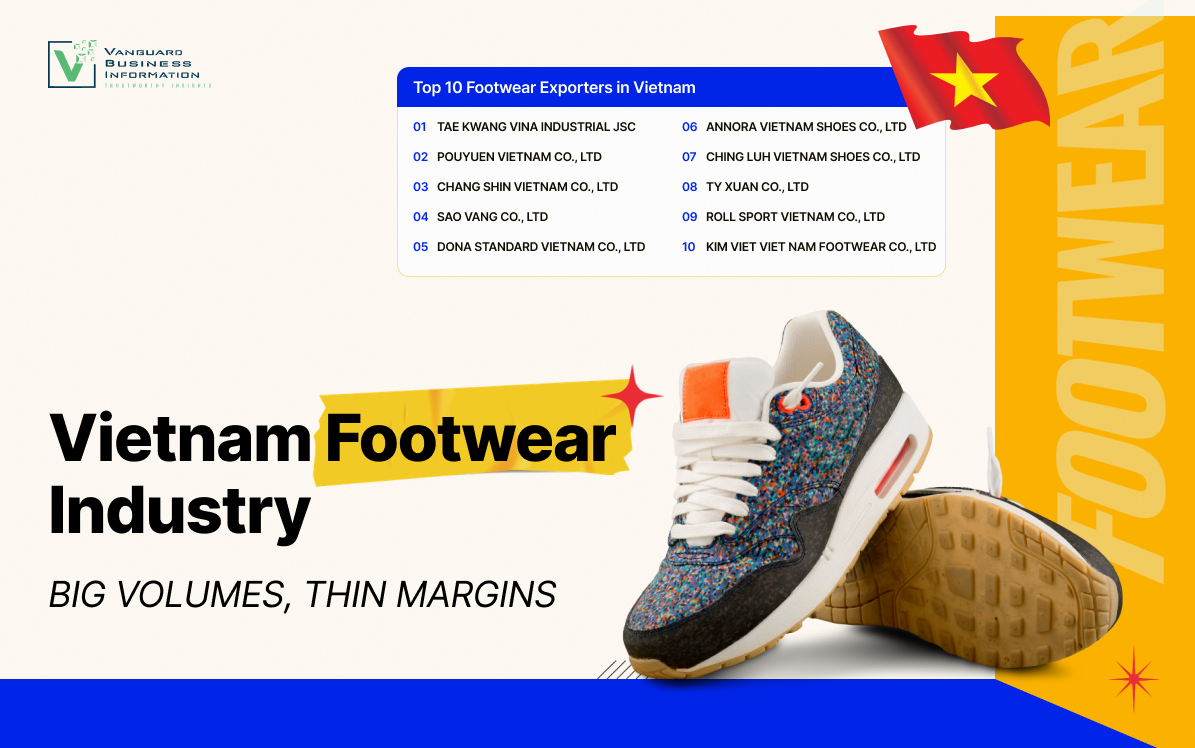
Vietnam’s footwear industry remains one of the country’s most important export-oriented manufacturing sectors. With an annual production capacity of approximately 1.4 billion pairs of shoes, Vietnam currently ranks as the third-largest footwear producer globally, behind only China and India. More importantly, Vietnam ranks second worldwide in footwear exports, shipping an estimated 1.3 billion pairs per year, second only to China.
This scale reflects not only Vietnam’s manufacturing capacity but also its deep integration into global supply chains. Over the past two decades, footwear has evolved from a labor-intensive domestic industry into a cornerstone of Vietnam’s export economy, primarily driven by foreign direct investment (FDI), global brand outsourcing, and favorable trade agreements.
Export Performance in 2025: A Data-Driven Recovery
In 2025, Vietnam’s footwear exports are estimated to reach USD 24.4 billion, a 6.7% increase from 2024. This recovery follows a period of global demand volatility and reflects improving consumption trends in major markets.
According to Vietnam Customs data, footwear exports in November 2025 reached USD 2.07 billion, down 4.0% year-on-year. However, cumulative performance tells a more positive story. In the first 11 months of 2025, Vietnam’s footwear exports totaled USD 21.9 billion, up 5.5% compared to the same period in 2024.
Footwear currently stands as Vietnam’s fifth-largest export category, after mobile phones, computers, machinery, and textiles & garments, accounting for 6.4% of total national export turnover in 2025. This confirms the industry’s continued macroeconomic relevance despite increasing global competition.
Export Markets: Geographic Breadth and Demand Trends
Vietnam’s footwear export markets are geographically diversified, spanning the Americas, Europe, and Asia. Among these, the United States remains the single largest destination, accounting for 34.7% of total footwear export value in November 2025, followed by the European Union with 26.2%.
For the first 11 months of 2025, exports recorded solid growth across multiple markets:
- United States: +7.0%
- European Union: +6.0%
- Japan: +11.0%
- United Kingdom: +7.6%
- Mexico: +34.0%
- Canada: +18.1%
- Australia: +11.7%
- UAE: +19.2%
Within the EU, performance varied significantly by country. Italy (+31.4%), Sweden (+35.7%), France (+13.1%), and the Netherlands (+10.3%) recorded strong growth, while Belgium, Germany, and Luxembourg experienced declines, reflecting uneven consumption recovery and inventory adjustments across Europe.
Vietnam’s Role in the Global Footwear Value Chain
Vietnam’s integration into the global footwear value chain is best illustrated by its role as a core manufacturing hub for major international brands, notably Nike. Approximately 50% of Nike’s global output—around 300 million pairs annually—is produced in Vietnam, highlighting the country’s strategic importance to multinational footwear companies.
However, this integration comes with structural limitations. Vietnam’s participation in the value chain remains concentrated at the final assembly and processing stage, where value-added margins are relatively low. While products are globally recognized as “Made in Vietnam,” most design, branding, advanced materials, and high-margin intellectual property remain under the control of overseas brand owners.
As a result, Vietnam captures only a small fraction of total value creation, despite its dominant role in physical production. This structural issue continues to constrain income growth, technological upgrading, and domestic brand development.
Competitive Advantages – and Their Constraints
Several factors underpin Vietnam’s competitiveness in footwear manufacturing:
First, Vietnam has effectively leveraged tariff preferences under multiple free trade agreements (FTAs), enabling footwear products to enter major markets at more competitive prices.
Second, low labor costs, averaging USD 181–200 per month, remain a key attraction for global manufacturers. Combined with a disciplined workforce and established industrial clusters, this has helped Vietnam retain large-scale production contracts.
However, these advantages are increasingly under pressure. Rising wages, tightening labor availability, and stronger competition from other low-cost manufacturing countries are gradually eroding Vietnam’s cost-based edge. Overreliance on imported raw materials further exposes the industry to external supply shocks.
Export Growth Targets and Strategic Transformation
Vietnam’s footwear industry has set ambitious growth targets. Exports are projected to reach USD 29 billion in 2025, a 10% year-on-year increase. Looking further ahead, under the national textile and leather–footwear development strategy, Vietnam aims to achieve USD 38–40 billion in footwear and handbag exports by 2030, with a long-term vision to 2035.
To support these targets, enterprises are increasingly shifting toward green, circular, and environmentally friendly production models. Improving the localization rate of materials and components is also a strategic priority, aimed at reducing dependence on imports and strengthening supply chain resilience.
In parallel, companies are actively exploring new consumer markets such as the Middle East, Arab countries, and Africa, while continuing to consolidate their presence in traditional markets.
Sustainability Pressures and Regulatory Challenges
Despite positive export prospects, the footwear industry faces mounting challenges from sustainability and compliance requirements. Major markets such as the EU and the United States are tightening regulations related to environmental protection, supply chain transparency, and waste management.
The EU—accounting for a significant share of Vietnam’s footwear exports—has introduced a series of impactful regulations, including supply chain due diligence requirements, anti-deforestation rules, and extended producer responsibility (EPR) obligations. These regulations impose strict standards on raw material sourcing, production processes, and post-consumption waste handling.
Compliance with these frameworks requires substantial investment, technological upgrades, and operational restructuring, creating significant pressure on Vietnamese manufacturers, particularly small and medium-sized enterprises.
Top 20 Footwear Exporters in Vietnam
|
Rank |
Company Name |
Export Value (USD ‘000) |
|
1 |
1,119,018 |
|
|
2 |
965,088 |
|
|
3 |
839,458 |
|
|
4 |
523,489 |
|
|
5 |
484,338 |
|
|
6 |
404,525 |
|
|
7 |
356,917 |
|
|
8 |
333,055 |
|
|
9 |
324,332 |
|
|
10 |
311,890 |
|
|
11 |
308,795 |
|
|
12 |
301,981 |
|
|
13 |
301,811 |
|
|
14 |
295,563 |
|
|
15 |
295,132 |
|
|
16 |
267,277 |
|
|
17 |
251,652 |
|
|
18 |
249,244 |
|
|
19 |
240,804 |
|
|
20 |
237,240 |
The list highlights the dominant role of FDI enterprises, particularly those affiliated with global footwear groups and international brands.
Data, Transparency, and the Role of VNBIS
As Vietnam’s footwear industry becomes more complex and compliance-driven, reliable company-level data is increasingly critical. Vanguard Business Information LLC (VNBIS) maintains one of the largest and most comprehensive databases of Vietnamese enterprises, covering legal status, ownership structure, financial performance, export activity, and risk indicators.
For investors, buyers, insurers, and financial institutions, access to accurate and up-to-date data through VNBIS enables better supply chain due diligence, risk assessment, and strategic decision-making in a rapidly evolving global trade environment.
Critical structural challenges.
Vietnam’s footwear industry enters 2025 with renewed export momentum, strong global positioning, and ambitious long-term targets. However, beneath the headline growth figures lie structural challenges related to value capture, sustainability compliance, and heavy dependence on foreign-led production models.
Whether Vietnam can move beyond its current role as a low-margin manufacturing base and secure a deeper position in the global value chain will depend on policy support, enterprise transformation, and data-driven decision-making, areas where transparency and high-quality business intelligence will increasingly play a decisive role.