Published Jan 2026
Vietnam’s Money Market Under Pressure
From USD/VND stability and free-market pressure to gold premiums and intensifying deposit-rate competition, Vietnam’s monetary landscape in early 2026 reflects a system under strain yet firmly anchored by central-bank intervention.
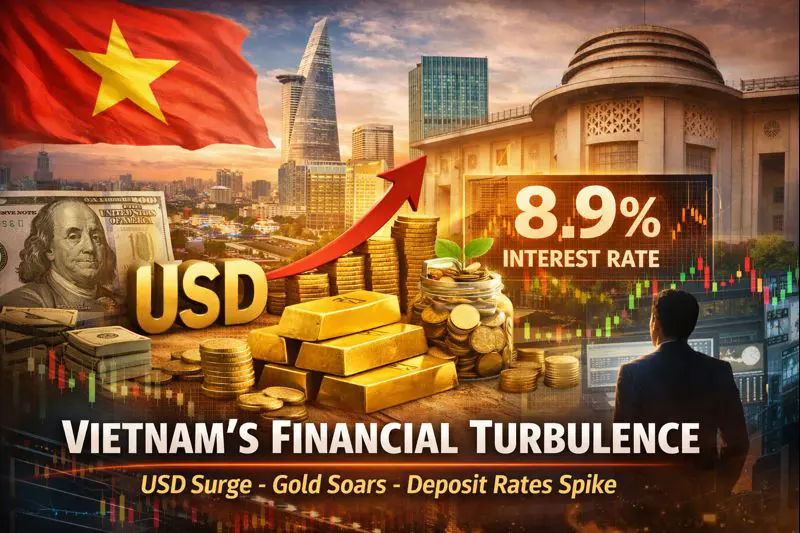
As Vietnam enters the final weeks ahead of the 2026 Lunar New Year, the country’s monetary and financial markets are showing clear signs of short-term stress but medium-term stabilization. Movements in the USD/VND exchange rate, gold prices, deposit interest rates, and interbank liquidity all point to a system under seasonal pressure, yet still firmly anchored by policy discipline from the State Bank of Vietnam (SBV).
Taken together, recent developments provide a comprehensive snapshot of Vietnam’s monetary conditions in late 2025 and early 2026, as well as clues about how the coming months may unfold.
USD/VND: Stability in the System, Pressure in the Free Market
During the week from January 19 to January 22, 2026, the USD/VND exchange rate at commercial banks fluctuated within a narrow and controlled band. At Vietcombank, the benchmark USD/VND rate edged down by VND 10/USDon both the buying and selling sides, settling at VND 26,051–26,381/USD. Compared with the start of 2026, the selling rate was almost unchanged, up only 0.02%, underscoring the SBV’s success in maintaining exchange-rate stability.
By contrast, the free (informal) USD market showed a more pronounced reaction. Driven by foreign-currency hoarding, overseas travel demand, and remittance-related cash needs ahead of Tết, free-market USD prices rose to VND 26,650–26,700/USD, widening the gap with bank rates to roughly VND 300–350/USD.
At the SBV’s Transaction Office, both buying and selling rates were adjusted downward by VND 10/USD, remaining comfortably below the official ceiling. The central exchange rate, set at VND 25,125/USD, continued to move within a tight range, reinforcing confidence in the SBV’s flexible yet disciplined policy approach.
What Is Driving the Exchange Rate?
Global Factors: A Volatile U.S. Dollar
Internationally, the U.S. Dollar Index (DXY) experienced sharp swings during the same period. Trade tensions between the U.S. and the EU—particularly around the Greenland issue—triggered a brief “Sell America” wave, pushing DXY down to 98.44 points on January 20.
Sentiment improved after U.S. President Donald Trump’s speech at the World Economic Forum in Davos, where he signaled restraint and trade compromise. The DXY recovered to 98.753 points by January 22. Still, on a weekly basis, the USD weakened against most major currencies, reflecting uncertainty around U.S. trade policy and interest-rate expectations.
Markets currently expect the Federal Reserve to hold rates steady in the near term, with the possibility of 50 basis points of cumulative cuts in the second half of 2026—a factor that may cap USD strength later this year.
Domestic Factors: Seasonal Demand and Liquidity Management
At home, import demand for Tết, year-end contract settlements, and precautionary FX needs pushed short-term USD demand higher. At the same time, the SBV absorbed more than VND 120 trillion via treasury bill operations since the start of the year, easing inflation and FX pressures while tightening VND liquidity.
Looking ahead, forecasts from UOB, MBS, and Standard Chartered suggest that USD/VND pressures will cool after Tết, with the exchange rate likely retreating toward the VND 26,200–26,300/USD range as seasonal demand fades.
Gold Market: From Global Shock to Domestic Fever
Global Gold: Record Highs on Geopolitical Anxiety
Gold markets were among the most volatile assets in January. Between January 19 and 21, global gold prices surged by more than USD 60/oz, breaking successive historical records and peaking at USD 4,888/oz. The rally was driven almost entirely by U.S.–EU geopolitical tensions, trade threats, and rising safe-haven demand.
On the morning of January 22, prices corrected modestly to around USD 4,802/oz after easing rhetoric from U.S. leadership at Davos.
Vietnam’s Gold Market: Structural Premiums Persist
Domestically, gold prices mirrored the global surge—but with greater intensity. SJC gold bullion briefly reached VND 170.7 million per tael, while 9999 gold rings traded in the VND 165–170 million range.
Notably, domestic gold prices remained VND 16–18 million per tael higher than global prices after conversion—a structurally wide premium that poses risks for buyers chasing prices at elevated levels. Strong pre-Tết demand for luck and wealth preservation continues to underpin local prices, even when global markets correct.
Deposit Interest Rates: A Broad-Based Uptrend Emerges
One of the most striking developments in early 2026 has been the unexpected surge in deposit interest rates. In the first three weeks of January alone, around 13 banks raised deposit rates, reflecting rising liquidity pressure and renewed credit demand.
The banking system’s loan-to-deposit ratio (LDR) has climbed to 83–85%, forcing institutions to compete aggressively for medium- and long-term funding—especially as regulations tighten limits on short-term funds used for long-term lending.
Several banks now offer exceptionally high rates, ranging from 6.5% to as high as 9% per year, albeit often with strict deposit-size conditions. At the same time, many banks are listing rates above 6.5% per year without minimum balance requirements, signaling a genuine structural shift rather than isolated promotional activity.
Lending Rates and Interbank Liquidity: Still Under Control
Despite rising deposit rates, lending rates remain relatively contained. Average VND lending rates for new and outstanding loans range from 6.7% to 9.0% per year, while short-term VND loans for priority sectors average just 3.9%, below the SBV’s regulatory ceiling.
USD lending rates remain stable at 4–5% per year, supported by the SBV’s policy of 0% USD deposit rates, which discourages dollarization.
Meanwhile, interbank rates have cooled significantly from early-January spikes. After briefly surging close to 7% overnight, rates normalized by the third week of January, with overnight rates falling to 2.84%, reflecting effective SBV liquidity intervention.
Outlook: Tight in the Short Term, Stable in the Medium Term
Looking ahead, Vietnam’s monetary environment is likely to remain tight but manageable through the first quarter of 2026. Seasonal FX demand, elevated gold premiums, and deposit-rate competition will persist in the short term. However, strong remittance inflows, a projected USD 24 billion trade surplus, and disciplined central-bank management should help stabilize markets after Tết.
In this context, Vietnam’s financial system enters 2026 not without challenges—but with policy credibility intact, liquidity tools well deployed, and a clear path toward normalization in the months ahead.