Published Dec 2025
Vietnam’s Pepper Exports Approach US$ 1.6 Billion in 2025, but Structural Risks Persist
Vietnam’s pepper exports are heading toward the USD 1.6 billion mark in 2025, driven by high prices and resilient global demand. Behind the strong headline figures, however, lie structural challenges, market concentration, and growing dependence on foreign exporters, factors that will shape the industry’s resilience in the years ahead.
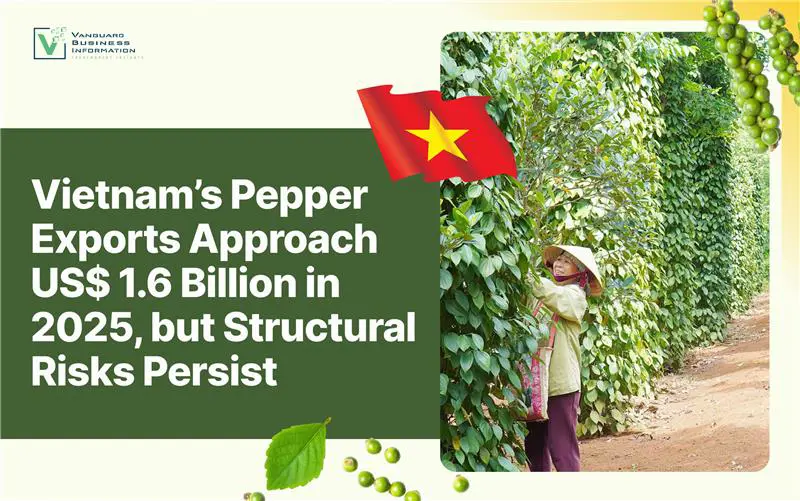
Vietnam’s pepper industry is on track to record export turnover of more than USD 1.6 billion in 2025, driven largely by higher export prices rather than volume growth.
While the headline numbers appear strong, a closer look at market structure, ownership concentration, and external dependencies reveals significant underlying uncertainties that continue to shape the sector’s outlook.
Higher Export Value Masks Falling Volumes
By the end of the first 11 months of 2025, Vietnam exported about 223.2 thousand tons of pepper, a 5.0% decrease compared to the previous year. Meanwhile, export value reached USD 1.5 billion, a 24.1% increase from the same period in 2024. This difference between volume and value highlights a key point: growth in 2025 is driven by prices, not by increased production.
In November 2025 alone, exports reached 18.01 thousand tons, valued at USD 118.5 million. Compared to November 2024, both volume and value grew, but monthly figures showed declines, highlighting the fragility of short-term momentum amid volatile global demand.
With one month remaining, total export turnover is likely to exceed USD 1.6 billion, but this outcome depends heavily on price stability rather than a recovery in output.
Export Prices Are Elevated, but Sustainability Is Uncertain
Vietnamese pepper prices remained historically high throughout 2025. The average export price reached USD 6,580 per ton in November and averaged USD 6,765 per ton over the first 11 months, up more than 30% year on year.
However, these price levels are closely tied to global supply tightness and speculative cycles, both of which can reverse quickly. Any normalization of production in competing countries, such as Brazil, or changes in global consumption could place downward pressure on prices, exposing Vietnam’s continued decline in export volumes.
Market Concentration and Dependence on the United States
The United States remained Vietnam’s largest pepper export market, accounting for 22.5% of total export volume in the first 11 months of 2025. Exports to the U.S. reached USD 373.4 million, offering relatively higher margins compared with other destinations.
Yet, reliance on the U.S. market also creates exposure to policy risk and demand shifts. Although recent tariff exemptions for agricultural products have supported trade flows, these measures are administrative decisions rather than binding trade commitments, and can change with political cycles.
|
Market |
Nov 2025 Volume |
Nov 2025 Value |
Change vs Nov 2024 Volume (%) |
Change vs Nov 2024 Value (%) |
11 months 2025 Volume |
11 months 2025 Value |
Change vs 11 months 2024 Volume (%) |
Change vs 11 months 2024 Value (%) |
|
United States |
4,312 |
32,232 |
-22.40 |
-18.09 |
50,162 |
373,435 |
-28.06 |
-1.02 |
|
Germany |
959 |
7,400 |
24.71 |
29.23 |
15,044 |
114,790 |
-0.47 |
34.44 |
|
UAE |
1,748 |
10,915 |
335.91 |
295.70 |
11,382 |
72,677 |
-18.66 |
-3.74 |
|
India |
231 |
1,624 |
-44.34 |
-43.52 |
10,553 |
74,229 |
6.75 |
58.26 |
|
Netherlands |
621 |
4,719 |
-19.97 |
-16.37 |
8,052 |
64,410 |
-19.45 |
11.00 |
|
Philippines |
617 |
3,157 |
16.20 |
28.50 |
7,016 |
36,923 |
-3.48 |
22.68 |
|
Thailand |
667 |
4,620 |
23.98 |
13.36 |
6,965 |
53,097 |
29.82 |
58.30 |
|
United Kingdom |
462 |
2,966 |
14.36 |
0.16 |
6,602 |
49,618 |
16.79 |
67.10 |
|
South Korea |
331 |
2,487 |
-42.83 |
-34.72 |
6,558 |
45,015 |
-1.72 |
19.50 |
|
Egypt |
652 |
3,873 |
805.56 |
799.21 |
6,298 |
38,238 |
21.49 |
51.50 |
|
Russia |
270 |
1,690 |
-11.76 |
-17.45 |
5,625 |
37,632 |
-6.00 |
19.00 |
|
Pakistan |
362 |
2,227 |
13.84 |
3.40 |
4,941 |
31,332 |
-10.25 |
24.30 |
|
Türkiye |
307 |
1,916 |
26.86 |
25.44 |
4,538 |
27,526 |
7.43 |
47.30 |
|
Japan |
384 |
2,390 |
-37.56 |
-31.70 |
4,211 |
25,270 |
0.50 |
32.10 |
|
Saudi Arabia |
396 |
2,684 |
86.79 |
75.06 |
3,994 |
26,834 |
30.74 |
67.70 |
|
Canada |
254 |
1,863 |
2.42 |
11.40 |
3,696 |
26,437 |
-4.74 |
21.20 |
|
Spain |
341 |
2,278 |
26.30 |
31.07 |
2,936 |
21,883 |
-9.66 |
20.40 |
|
France |
216 |
1,513 |
116.00 |
222.33 |
2,860 |
15,956 |
-31.45 |
-26.10 |
Table 1: Vietnam's Pepper export markets in November and 11 months of 2025 (Unit: Volume: tons; Value: thousand USD)
Meanwhile, growth in secondary markets such as Thailand, the United Kingdom, and Egypt has been strong, but often from smaller bases and with less predictable long-term demand.
Structural Dependence on Foreign-Invested Exporters
One of the most critical features of Vietnam’s pepper industry is its high level of concentration and dependence on foreign-invested enterprises.
Although Vietnam has around 200 pepper processing and trading companies, export power is highly centralized:
- The top 15 exporters account for roughly 70% of national export volume
- Foreign-invested companies control nearly 30% of market share
In practice, Vietnam’s pepper exports depend heavily on multinational groups such as Olam, Nedspice, Synthite, and other foreign-controlled traders. These companies play a dominant role in sourcing, processing, financing, and market access, particularly for high-standard markets in the U.S. and EU.
While foreign investment has improved processing capacity and compliance standards, it also means that pricing power, contract terms, and market access are often controlled outside Vietnam. Domestic enterprises, especially smaller processors and traders, remain vulnerable to shifts in procurement strategies by these global players.
Production Constraints and Sustainability Pressures
Beyond trade structure, Vietnam’s pepper production faces long-term constraints. Output has declined in recent years due to aging plantations, rising input costs, climate variability, and tighter environmental standards.
At the same time, key markets—especially the EU—are enforcing stricter rules on pesticide residues, traceability, and carbon emissions. Meeting these requirements requires investment in organic inputs, water-saving systems, and sustainable farming models. While such investments can raise product value, they also increase costs and reduce flexibility for smallholders.
Leading Exporters Highlight the Concentration Risk
Export turnover rankings in the first 10 months of 2025 confirm this concentration. A small group of companies—including Olam Vietnam, Phuc Sinh, Nedspice, Tran Chau Group, Son Ha, Synthite Vietnam, Expo Commodities (Vietnam) and a handful of others—dominated export revenues.
For banks, insurers, and buyers, understanding who controls export flows, which markets they serve, and how financially resilient they are is becoming as important as tracking total export figures.
Pepper Exporting Enterprises with High Export Turnover in the First 10 Months of 2025
|
No. |
Enterprise |
Export Turnover (thousand USD) |
|
1 |
120,117 |
|
|
2 |
116,855 |
|
|
3 |
105,223 |
|
|
4 |
82,228 |
|
|
5 |
79,323 |
|
|
6 |
70,684 |
|
|
7 |
54,729 |
|
|
8 |
53,050 |
|
|
9 |
50,392 |
|
|
10 |
39,128 |
|
|
11 |
31,329 |
|
|
12 |
31,134 |
|
|
13 |
29,917 |
|
|
14 |
29,854 |
|
|
15 |
26,271 |
|
|
16 |
24,017 |
|
|
17 |
21,148 |
|
|
18 |
20,643 |
|
|
19 |
20,540 |
|
|
20 |
18,569 |
Table 2: Top 20 pepper exporters in the first 10 months of 2025. Source data: From the Vietnam Customs Office.
Why Granular Data Matters More Than Ever
In a context where export growth relies heavily on price cycles, foreign-controlled supply chains, and policy-sensitive markets, headline statistics alone are no longer sufficient.
VNBIS (Vanguard Business Information LLC) provides detailed, company-level and market-level intelligence, including:
- Import–export transaction data by market
- Identification of leading exporters and their financial profiles
- Ownership and FDI exposure analysis
- Risk indicators related to market concentration and dependency
As Vietnam’s pepper exports approach the USD 1.6 billion mark, the key question is not only how high exports can go, but how resilient the industry is when prices soften or market conditions change. In this environment, data-driven insight is essential for informed decision-making.