Published Mar 2026
Vietnam Breaks Its Own Coffee Export Record
Vietnam's coffee industry opened 2026 with a milestone no one had seen before: a single month of exports surpassing USD 1 billion. January 2026 delivered USD 1.08 billion in export turnover, a 48% year-on-year surge, cementing Vietnam's position not just as a volume powerhouse, but as a rising force in global coffee value. This report breaks down the numbers, the markets, and the companies driving one of Vietnam's most remarkable trade achievements.
VIETNAM BREAKS ITS OWN COFFEE EXPORT RECORD
A WATERSHED MOMENT FOR VIETNAMESE COFFEE
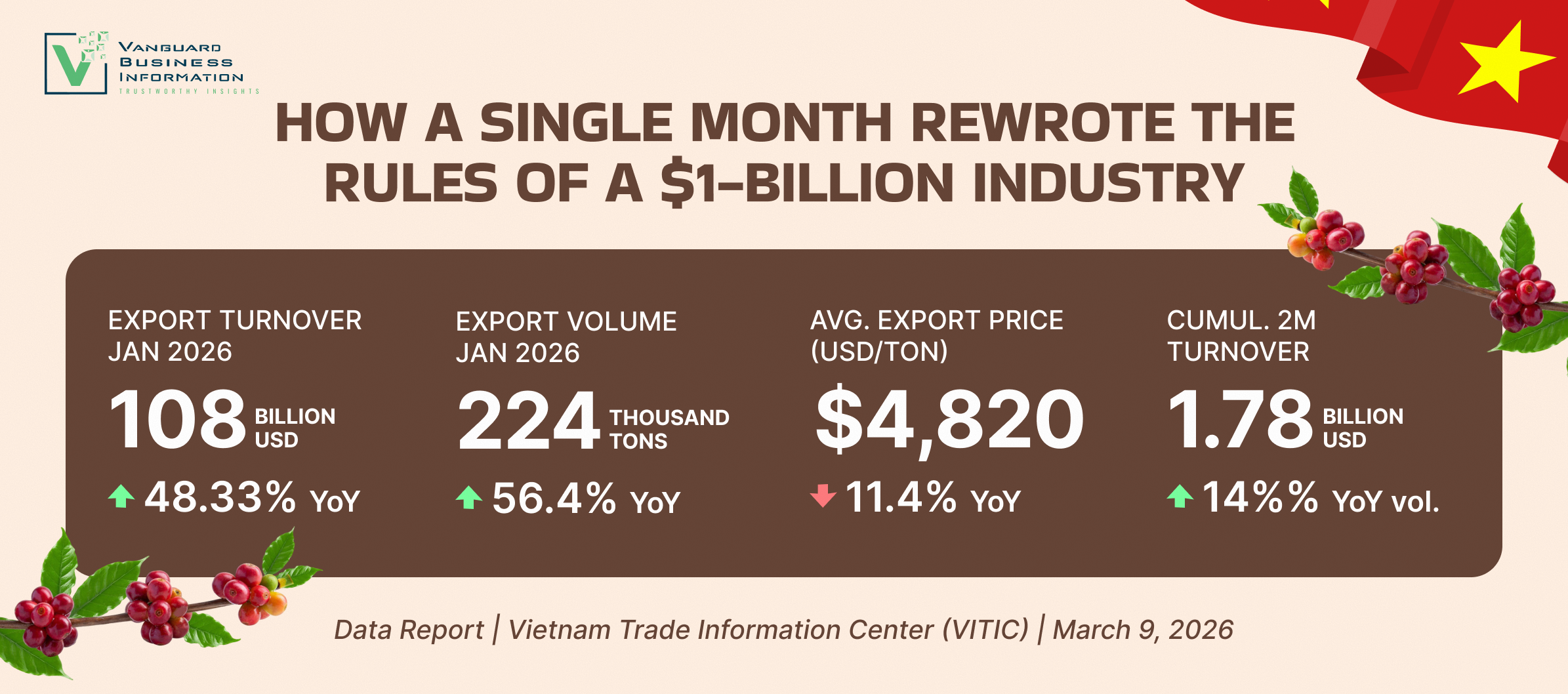
January 2026 will be remembered as the month when Vietnamese coffee exports crossed the USD 1 billion threshold for the first time. Total export turnover reached USD 1.08 billion, a surge of 48.33% compared to January 2025 and a sequential gain of 14.06% over December 2025. Export volume stood at 224,348 tonnes, rising 56.4% year-on-year, even as the average export price declined 11.4% to USD 4,820 per tonne, reflecting the intense competitive pricing environment that has characterised global coffee markets in recent months.
The milestone is not merely symbolic. It signals that Vietnamese coffee has evolved from a commodity traded largely on volume to a product that commands growing value in some of the world's most discerning markets. Coffee now accounts for 2.50% of Vietnam's total merchandise export structure, placing it firmly among the top agricultural, forestry, and fishery exports by value.
THE GLOBAL STAGE: SUPPLY, DEMAND, AND PRICE SIGNALS
The record export figure came amid nuanced global coffee dynamics. According to the International Coffee Organization (ICO), the Composite Indicator Price (I-CIP) averaged 296.89 US cents per pound in January 2026, a 2.6% decline from the previous month. Prices traded in a narrow band throughout January, at a level broadly described as slightly too low to trigger large-scale producer selling yet high enough to keep farmers active and confident in their transactions.
By February 2026, the picture shifted. Both Arabica and Robusta prices fell sharply as markets priced in higher global supply and the possibility of oversupply. Arabica dropped 0.2% to USD 3.08 per pound after briefly touching a five-month low of USD 3.06. Weather played its part as well: Minas Gerais, Brazil's primary Arabica-growing region, received above-average rainfall in January and February, particularly in the final week of February, creating favourable conditions for flowering and bean formation ahead of the new crop season.
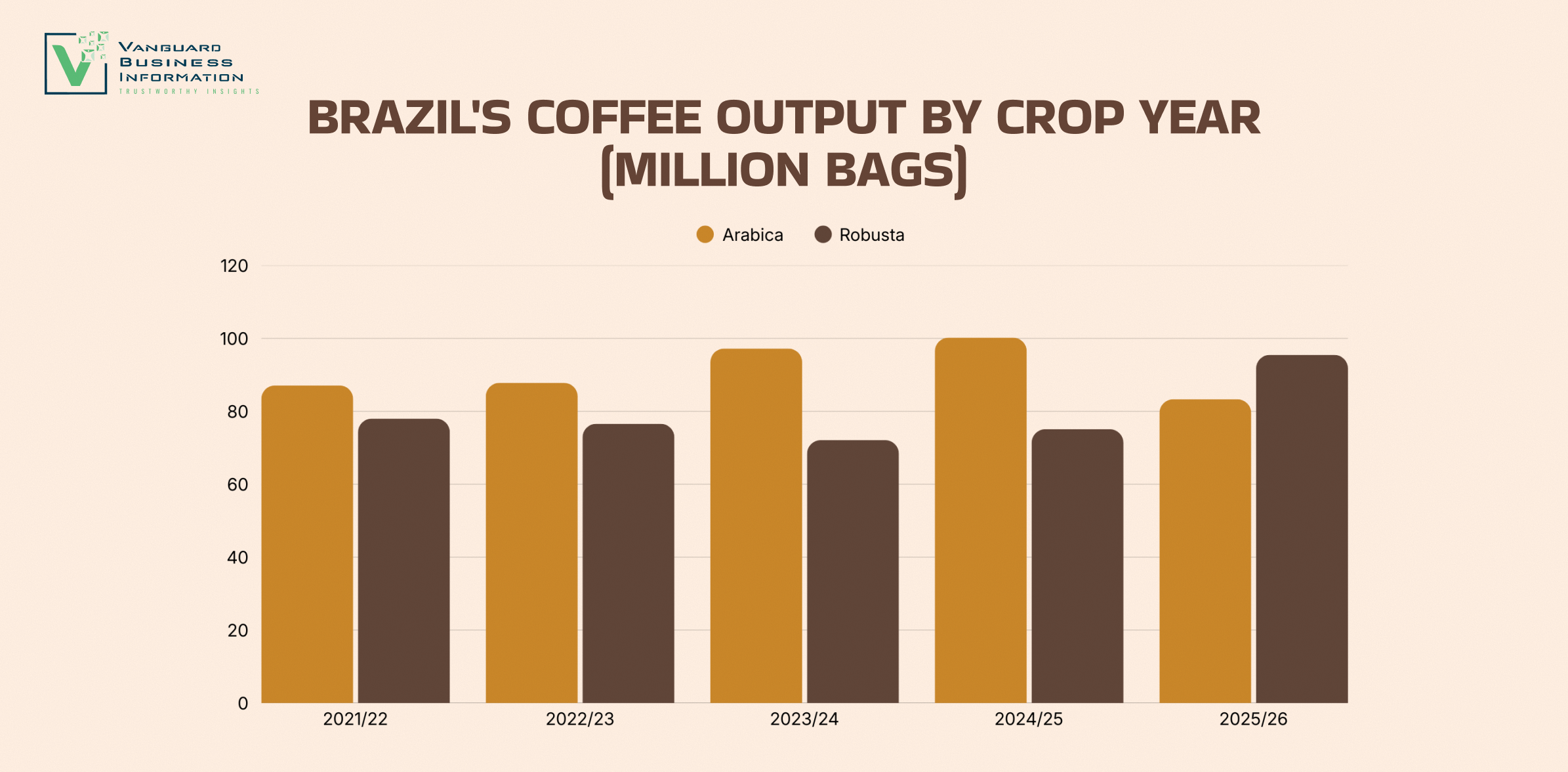
On the demand side, the picture remains encouraging. The USDA's latest semi-annual report projects global coffee production for the 2025/26 crop year to reach a record 178.8 million bags, a rise of 3.5 million bags (roughly 2%) over the previous season. This growth reflects a continued recovery in Vietnam, record-breaking output in both Indonesia and Ethiopia, and an offset against anticipated declines in Brazil and Colombia. Global consumption is forecast to reach its own record of 173.9 million bags, up 2.3 million bags year-on-year, with incremental demand coming from the European Union (+659,000 bags), the United States (+330,000 bags), Brazil (+310,000 bags), and the Philippines (+560,000 bags).
GERMANY PULLS FURTHER AHEAD AS VIETNAM'S TOP MARKET
Within Vietnam's coffee export geography, Germany remained the single largest destination by a considerable margin. German imports of Vietnamese coffee totalled USD 175.46 million in January 2026, representing a 16.23% share of total export turnover. The figure rose 4.95% from December 2025 and surged 44.81% compared to January 2025. The achievement is even more striking in context: 2025 was the first full year in which Vietnam's coffee exports to Germany exceeded USD 1 billion, and the momentum has clearly carried into 2026.
Germany's appeal as a market is not simply a matter of proximity to other EU buyers. German consumers drink coffee daily at remarkably high rates: 72.7% of the population report drinking coffee at home, with additional consumption at the workplace (7.9%) and at friends' or relatives' homes (5.2%). The average German consumes 169 litres of coffee per year, more than the 90 litres per year attributed to beer. Crucially, German shoppers are willing to pay a premium for quality, making the market receptive to value-added Vietnamese coffee products beyond standard green beans.
Spain ranked second with USD 80.85 million in January 2026, accounting for a 7.48% share, up 53.28% month-on-month and 50.70% year-on-year. The strong performance of EVFTA member states, including Belgium, France, and Italy, underscores the commercial dividend of the EU-Vietnam Free Trade Agreement. Tariff preferences aside, demand among the growing Asian communities living, studying, and working across the EU has begun to create an additional structural tailwind for Vietnamese food and beverage exports.
KEY MARKET DATA: VIETNAM'S COFFEE EXPORTS IN JANUARY 2026
The table below presents the 10 leading destination markets by export value, alongside year-on-year growth rates forvolume and value. The divergence between markets such as China (+277.8% value growth) and India (+3,680.3%) and more mature markets such as the Netherlands (+2.5%) illustrates the breadth of the opportunity as well as the varying stages of market development across Vietnam's trading partners.
|
Market |
Volume (tonnes) |
Value (USD '000) |
Avg. Price (USD/t) |
YoY Vol. Growth |
YoY Value Growth |
Share (%) |
|
Germany |
39,660 |
175,460 |
4,424 |
+70.5% |
+44.4% |
16.23% |
|
Spain |
17,383 |
80,848 |
4,651 |
+84.4% |
+50.7% |
7.48% |
|
Italy |
18,614 |
80,341 |
4,316 |
+39.0% |
+17.4% |
7.43% |
|
Algeria |
16,292 |
73,759 |
4,527 |
+296.0% |
+246.3% |
6.82% |
|
Japan |
13,483 |
68,917 |
5,111 |
+39.0% |
+15.5% |
6.37% |
|
Russia |
13,664 |
65,527 |
4,796 |
+82.1% |
+67.8% |
6.06% |
|
USA |
12,330 |
60,567 |
4,912 |
+16.5% |
+14.8% |
5.60% |
|
Netherlands |
9,582 |
53,305 |
5,563 |
+2.3% |
+2.5% |
4.93% |
|
China |
8,807 |
50,338 |
5,716 |
+149.2% |
+277.8% |
4.66% |
|
Belgium |
9,035 |
42,625 |
4,718 |
+197.2% |
+179.4% |
3.94% |
Table 1: Vietnam's Coffee Export Performance by Market, January 2026. Source: Vietnam Customs Authority (preliminary)
China's exceptional year-on-year value growth of 277.8% warrants a note of context: the January 2025 base was suppressed by Lunar New Year preparation, which created an artificially low comparison point. India's growth of 3,680.3% in value terms similarly reflects a negligible base period. The more telling signal in both markets is that sustained growth, even at more moderate rates, would represent a meaningful diversification of Vietnam's traditionally Europe-centric coffee export book.
THE COMPANIES DRIVING VIETNAM'S EXPORT ENGINE
Behind the headline numbers sit the businesses that source, process and ship Vietnamese coffee to the world. The thirty largest coffee exporters by January 2026 turnover span a spectrum from domestically owned trading houses and cooperatives to subsidiaries of global commodity merchants. The ten leading companies alone accounted for a substantial share of total monthly export volume.
Top 10 Coffee Exporters from Vietnam, January 2026 (Thousand USD). Source: Vietnam Customs Authority (preliminary)
|
# |
Company |
Turnover (Thousand USD) |
Rank |
|
1 |
27,287 |
#1 |
|
|
2 |
25,969 |
#2 |
|
|
3 |
23,530 |
#3 |
|
|
4 |
16,925 |
#4 |
|
|
5 |
15,819 |
#5 |
|
|
6 |
11,997 |
#6 |
|
|
7 |
10,710 |
#7 |
|
|
8 |
9,248 |
#8 |
|
|
9 |
8,353 |
#9 |
|
|
10 |
8,130 |
#10 |
Table 2: Top 10 Coffee Exporting Companies from Vietnam, January 2026. Source: Vietnam Customs Authority (preliminary)
Tuan Loc Commodities retained the top position with USD 27.29 million in export value, followed closely by Vinh Hiep at USD 25.97 million and the Intimex Group at USD 23.53 million. The presence of Nestle Vietnam at number four reflects the importance of processed and soluble coffee in the export mix, as multinational food and beverage companies continue to use Vietnam as a manufacturing and export base for value-added products. Further down the list, the appearance of global traders such as Louis Dreyfus and Olam Vietnam alongside domestic cooperatives and private firms captures the full ecosystem of actors that give Vietnamese coffee its global reach.
WHAT LIES AHEAD: OUTLOOK FOR VIETNAMESE COFFEE IN 2026
The pace set in January 2026 is unlikely to be sustained month-to-month. Cumulative export data through February 2026 confirms this: estimated volumes for February fell to 141,000 tonnes, a 37% sequential decline and a 20.4% year-on-year drop, while turnover of USD 672 million fell 33% against February 2025. Combined two-month volume of 366,000 tonnes nevertheless runs 14% ahead of the same period in 2025, and cumulative turnover of USD 1.78 billion is only marginally below the prior-year comparison despite the lower average price environment.
The USDA forecasts Vietnam's 2025/26 crop output at 30.8 million bags, supported by higher yields due to favourable weather and growers' ability to invest more in fertilisers and inputs, as coffee prices have remained elevated relative to historical norms. Vietnam's cultivation area stands at approximately 710,000 hectares, with the provinces of Dak Lak, Lam Dong, and Gia Lai constituting the production heartland.
On the demand side, the global market is transitioning from a period of supply deficit toward balance in 2026, which introduces the prospect of moderate price pressure as supply recovers. However, consumer demand continues to grow across virtually all major markets, and the regulatory environment, particularly the EU's increasingly stringent requirements around supply chain transparency and deforestation compliance, is creating both challenges and competitive moats for exporters that can demonstrate robust traceability. Vietnamese exporters that invest in certification, provenance documentation, and sustainable sourcing practices now stand to gain lasting advantages in the high-value segments of the European and Japanese markets, where such credentials increasingly determine purchasing decisions.
In the immediate term, the first quarter of 2026 is expected to deliver a stable export performance broadly in line with the same period in 2025. The industry's medium-term trajectory, however, is pointed firmly upward, and the January 2026 milestone has given producers, traders and policymakers alike a tangible proof point that Vietnamese coffee is ready to compete at the very highest levels of the global market.
ABOUT THE DATA PROVIDER
Jimmy Le | Founder & Managing Director, VNBIS
The data, corporate profiles, and industry intelligence that underpin the analysis in this article were researched, compiled, and structured by Jimmy Le and his team at VNBIS (Vanguard Business Information Services). Jimmy Le is a specialist in Vietnamese trade data, corporate risk intelligence, and cross-border business information, with extensive experience supporting clients across the financial services, insurance, investment, and commodities sectors.
VNBIS compiles and organizes detailed export and import transaction records from Vietnam Customs, cross-referencing them with corporate registry data, financial disclosures, and sector-level intelligence. This helps identify top exporters based on revenue, payment methods, and target markets, providing the factual foundation for sector reports like those on coffee, textiles, and timber featured in this bulletin.
Clients, investors, insurers, and trade finance professionals seeking to verify counterparty credentials, assess supply chain exposure, or conduct due diligence on Vietnamese enterprises are invited to visit www.vnbis.com to explore the full suite of business intelligence and risk management tools available, including company profiles, export performance data, credit risk indicators, and sector benchmarks designed to help stakeholders make informed decisions and control commercial risk effectively.
Source: Vanguard Business Information LLC; Ministry of Trade of vietnam, GSO Data and Vietnam Customs Authority