Published Mar 2026
Vietnam Pepper Exports January 2026: Strong Year-on-Year Growth Amid Global Headwinds
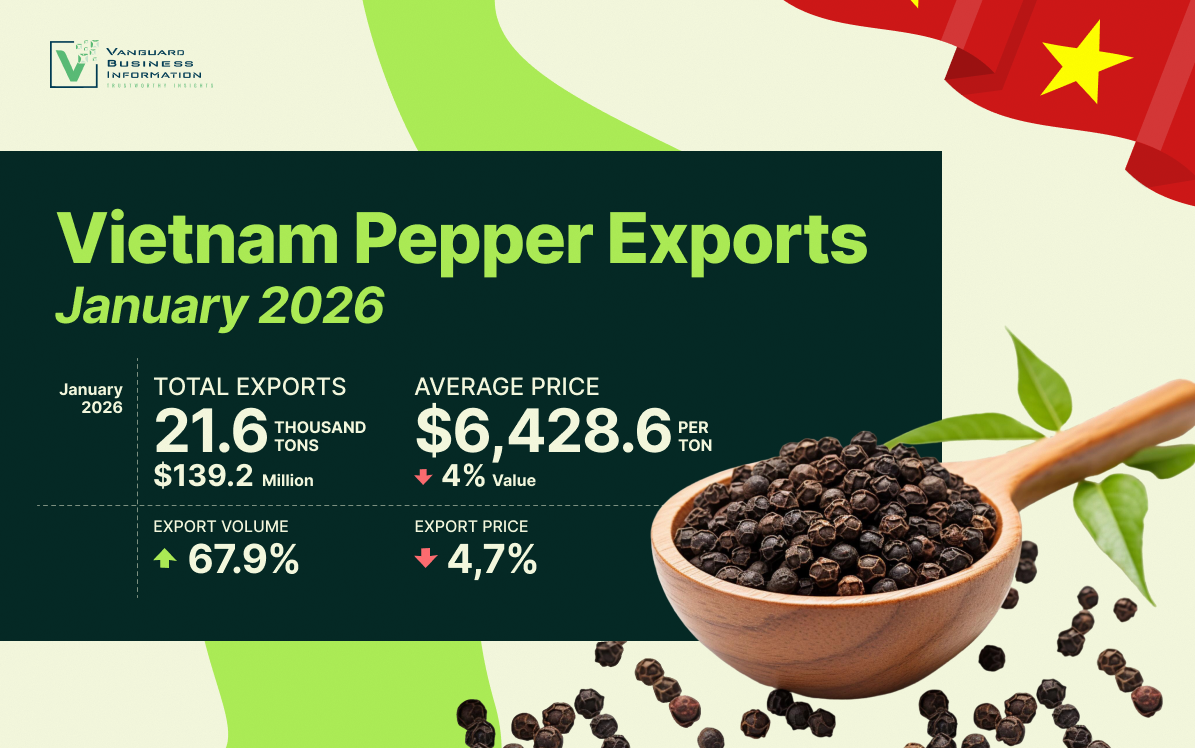
Vietnam's pepper industry entered 2026 with strong momentum. According to official data from the Vietnam Customs Department, total pepper exports in January 2026 reached 21,667 tonnes valued at USD 139.3 million, a remarkable year-on-year surge of 67.9% in volume and 60% in value compared to January 2025, reinforcing Vietnam's position as the world's leading pepper exporter.
Executive Summary
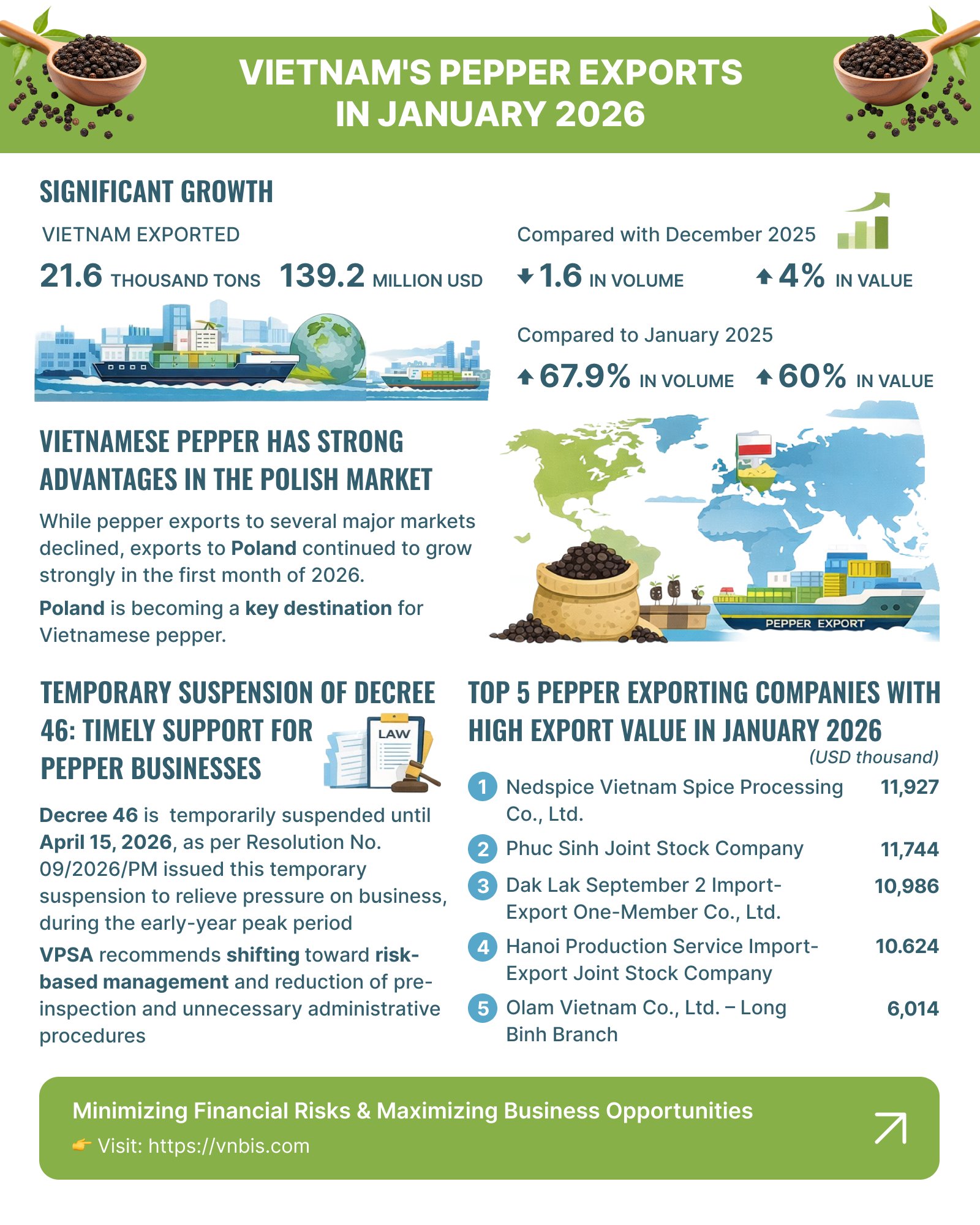
Vietnam's pepper industry entered 2026 with strong momentum. According to official data from the Vietnam Customs Department, total pepper exports in January 2026 reached 21,667 tonnes valued at USD 139.3 million — a remarkable year-on-year surge of 67.9% in volume and 60% in value compared to January 2025, reinforcing Vietnam's position as the world's leading pepper exporter.
While monthly figures showed modest softening relative to December 2025 (–1.6% in volume, –4.0% in value), the macro trajectory is decisively positive. Elevated year-on-year figures reflect both a low-base effect from early 2025 and genuine demand recovery in several key markets, including the United States, Thailand, the UAE, Canada, Poland, and Russia.
Key January 2026 Metrics at a Glance
|
Total Volume |
Total Value |
Avg. Export Price |
YoY Volume Growth |
|
21,667 tonnes |
USD 139.3 million |
USD 6,428.6/tonne |
+67.9% YoY |
1. Overall Export Performance in January 2026
Vietnam's pepper exports in January 2026 demonstrated resilient year-on-year growth despite a slight month-on-month correction. The 1.6% decline in volume and 4% drop in value compared to December 2025 largely reflect seasonal adjustments and cautious purchasing behavior by export companies awaiting clearer international price signals.
The average export price of Vietnamese pepper stood at USD 6,428.6 per tonne in January 2026, down 4.7% year-on-year. Despite this price adjustment, elevated price levels continue to support high overall export revenue. Vietnamese black pepper export prices remained in the USD 6,400–6,600 per tonne range (500 g/l and 550 g/l grades), keeping Vietnam competitive in the global spice market.
Supply and demand dynamics in January 2026 appeared temporarily balanced. Domestic pepper inventories held by farmers have diminished, reducing pressure to sell quickly. Simultaneously, export enterprises have adopted a cautious purchasing strategy, waiting for more definitive signals from the international market before committing to large volumes.
2. Key Export Market Analysis
2.1 United States: Dominant Market With Strong Recovery
The United States remained Vietnam's largest pepper export destination in January 2026, accounting for 24.5% of total export volume. The US market received 5,308 tonnes worth USD 38.85 million. While this represents a monthly decline of 10.6% in volume and 8.6% in value from December 2025, year-on-year growth was striking at +89.3% in volume and +80.5% in value — the strongest absolute value recovery among all destinations.
2.2 Thailand & UAE: Surging Asian Demand
Asian markets delivered the most dramatic growth stories in January 2026. Thailand surged to 1,223 tonnes (USD 8.93 million), up 354.7% in volume year-on-year. The UAE absorbed 933 tonnes (USD 5.5 million), an increase of 220.6%compared to the same period in 2025. These two markets, combined with the US and Germany, accounted for 38.9% of Vietnam's total pepper export volume.
2.3 Poland: Fastest-Growing Emerging Market
Among all destinations, Poland recorded the highest growth rate in January 2026. Export volume to Poland reached 357 tonnes (USD 2.12 million), rising by an extraordinary 264.3% in volume and 305.7% compared to January 2025. While Poland's absolute share remains modest, this growth trajectory signals an emerging, increasingly important corridor for Vietnamese pepper in Central Europe, even amid global economic uncertainty and geopolitical tensions.
2.4 Germany: Notable Contraction
Germany was the only major market to record a meaningful year-on-year decline in January 2026, with volumes falling 27.3% to 964 tonnes (USD 7.42 million) and value dropping 20.8%. This likely reflects softer demand from European food processors amid ongoing macroeconomic pressures in the eurozone. Germany nonetheless remains the third-largest individual market for Vietnamese pepper.
3. Vietnam Pepper Export Markets – January 2026
The following table presents official data from the Vietnam Customs Department on pepper exports by destination market, including month-on-month and year-on-year comparisons in both volume and value.
|
Market |
Volume (tonnes) |
Value (USD '000) |
vs Dec 2025 Vol % |
vs Dec 2025 Val % |
vs Jan 2025 Vol % |
vs Jan 2025 Val % |
|
Total |
21,667 |
139,288 |
-1.58% |
-3.95% |
+67.91% |
+59.96% |
|
United States |
5,308 |
38,849 |
-10.64% |
-8.57% |
+89.30% |
+80.50% |
|
Thailand |
1,223 |
8,928 |
-3.62% |
-7.24% |
+354.65% |
+305.94% |
|
Germany |
964 |
7,416 |
-14.16% |
-17.34% |
-27.30% |
-20.84% |
|
UAE |
933 |
5,501 |
-38.54% |
-41.47% |
+220.62% |
+175.52% |
|
India |
881 |
6,036 |
+12.09% |
+7.87% |
-7.07% |
-10.29% |
|
Philippines |
623 |
3,101 |
-11.88% |
-18.94% |
+41.59% |
+19.79% |
|
Netherlands |
581 |
4,530 |
-10.34% |
-12.66% |
+42.40% |
+39.09% |
|
South Korea |
488 |
3,557 |
+2.09% |
-4.03% |
-2.59% |
+3.62% |
|
Canada |
486 |
3,435 |
+2.32% |
+0.21% |
+174.58% |
+146.11% |
|
Russia |
470 |
3,109 |
+5.86% |
+5.50% |
+98.31% |
+92.17% |
|
United Kingdom |
438 |
3,234 |
-7.20% |
+0.62% |
-23.69% |
-23.89% |
|
Pakistan |
413 |
2,493 |
-25.85% |
-12.09% |
+5.90% |
-5.73% |
|
Poland |
357 |
2,120 |
+264.29% |
+213.03% |
+305.68% |
+258.03% |
|
France |
355 |
2,603 |
+258.59% |
+273.64% |
-12.13% |
+54.23% |
|
Spain |
341 |
2,411 |
+278.89% |
+275.49% |
+23.55% |
+15.46% |
Source: Vietnam Customs Department, January 2026
4. Domestic Price Landscape
Domestic pepper prices in Vietnam's key growing provinces remained stable in January 2026, reflecting cautious market sentiment from both farming communities and trading enterprises.
|
Province / Region |
Price (VND/kg) |
|
Đắk Lắk |
151,000 |
|
Đắk Nông |
151,000 |
|
Bà Rịa – Vũng Tàu |
149,000 |
|
Gia Lai |
148,500 |
|
Đồng Nai |
148,500 |
Source: Market reports, January 2026
The relative price stability reflects two converging factors: on-farm inventories are no longer abundant, removing the urgency to liquidate stocks, while trading companies are exercising patience, deferring large purchases until global price trends become clearer. This balanced, watchful state is expected to persist through the early first quarter of 2026.
5. International Pepper Price Benchmarks
According to the International Pepper Community (IPC), global pepper prices in early 2026 remain at historically elevated levels:
|
Origin |
Product |
Price (USD/tonne) |
|
Malaysia |
Black Pepper |
~USD 9,100 |
|
Indonesia |
Black Pepper |
~USD 6,899 |
|
Vietnam |
Black Pepper 500 g/l & 550 g/l |
USD 6,400–6,600 |
|
Brazil |
Black Pepper ASTA 570 |
~USD 6,125 |
Source: International Pepper Community (IPC), early 2026
Vietnamese pepper remains competitively priced against Indonesian origin and significantly undercuts Malaysian pepper, giving Vietnamese exporters a meaningful advantage in price-sensitive markets across Asia, Europe, and North America. Malaysian pepper's premium pricing partly reflects its higher quality grades and niche market position.
6. Top 20 Pepper Exporting Enterprises – January 2026
The following table lists the 20 Vietnamese companies with the highest pepper export value in January 2026, as reported by official customs data. Together, these enterprises account for the bulk of Vietnam's pepper export turnover and include major multinational processors, domestic champions, and specialized spice traders.
|
No. |
Enterprise |
Export Value (USD '000) |
|
1 |
11,927 |
|
|
2 |
11,744 |
|
|
3 |
10,986 |
|
|
4 |
Hanoi Import Export Production and Services Joint Stock Company |
10,624 |
|
5 |
6,014 |
|
|
6 |
5,841 |
|
|
7 |
5,511 |
|
|
8 |
5,408 |
|
|
9 |
4,679 |
|
|
10 |
4,458 |
|
|
11 |
4,004 |
|
|
12 |
3,736 |
|
|
13 |
2,888 |
|
|
14 |
2,733 |
|
|
15 |
2,543 |
|
|
16 |
2,465 |
|
|
17 |
2,400 |
|
|
18 |
2,363 |
|
|
19 |
1,696 |
|
|
20 |
1,614 |
Source: Vietnam Customs Department, January 2026
7. Spotlight on Leading Exporters
7.1 Nedspice Vietnam — #1 by Export Value
Nedspice Vietnam Spice Processing Co., Ltd. led all exporters with USD 11.93 million in export value in January 2026. A subsidiary of the Netherlands-based Nedspice Group, the company has operated in Vietnam since 1997 and manages two processing facilities — one in Binh Duong (near Ho Chi Minh City) and one in Binh Phuoc. The Binh Duong plant has a capacity of 24,000 tonnes per year. It holds BRC Grade A+, FSSC 22000, USDA Organic, Rainforest Alliance, and HALAL certifications, making it one of Vietnam's most technically advanced spice processing operations.
7.2 Phuc Sinh Corporation — #2 by Export Value
Phuc Sinh Corporation is Vietnam's foremost domestically-owned pepper exporter, recording USD 11.74 million in January 2026. Founded in 2001, the company has held the position of Vietnam's top pepper exporter since 2007, with an approximately 8% share of the global pepper trade. Operating five BRC-certified factories and a dedicated ISO/IEC 17025-accredited laboratory, Phuc Sinh is also the first Vietnamese company to export premium Green Pepper in Brine and Freeze-Dried Green Pepper to the US and EU markets. The company holds ISO 22000, KOSHER, and HALAL certifications.
7.3 Olam Vietnam — Global Scale in Vietnam
Singaporean agribusiness giant Olam Vietnam Co., Ltd. appears twice in the top 20 list — via its Long Binh Branch (USD 6.01 million, ranked #5) and its main entity (USD 1.61 million, ranked #20), reflecting the scale and diversified operations of its Vietnamese footprint. Olam's ofi (olam food ingredients) operates one of the largest spice processing facilities in the world in Ho Chi Minh City, and the group is widely recognized as one of the largest exporters of pepper, cashews, and instant coffee from Vietnam.
7.4 Intimex My Phuoc — Domestic Agribusiness Leader
Intimex My Phuoc Joint Stock Company (Binh Duong Branch) contributed USD 1.70 million in January 2026. A subsidiary of Intimex Group, one of Vietnam's largest agricultural processing and export conglomerates, the company leverages its strategic location in Binh Duong Province to aggregate raw materials from the Central Highlands for pepper and coffee processing and export.
8. Regulatory Environment: Temporary Suspension of Decree 46
A key development impacting Vietnam's pepper and spice trade in early 2026 is the temporary suspension of Decree No. 46/2026/NĐ-CP (detailed regulations for the Food Safety Law). The Vietnamese Government issued Resolution No. 09/2026/NQ-CP, suspending enforcement of the decree until April 15, 2026. During this period, the more business-friendly Decree No. 15/2018/NĐ-CP remains in effect.
The suspension addresses concerns from the Vietnam Pepper and Spice Association (VPSA), which argued that Decree 46's requirements — including mandatory country-of-origin approval, foreign facility recognition, and health certificates for each shipment — were misaligned with international norms for low-risk dried spices such as pepper. The VPSA noted that many exporting countries do not issue health certificates for dried spices, even when products meet all international standards.
The VPSA has proposed restructuring Article 10 of Decree 46 to allow greater regulatory flexibility for the dried spice category, calling for a shift toward risk-based inspection, reduced pre-clearance requirements, and greater reliance on testing results, compliance history, and enterprise risk classification. This regulatory relief has been described as timely and essential for maintaining uninterrupted trade flows during the peak business period at the start of the year.
9. Outlook and Key Factors to Watch
Vietnam's pepper sector is positioned for continued strong performance through 2026, provided several conditions hold:
- Global demand recovery: Sustained import activity from the US, Thailand, UAE, Canada, and emerging markets such as Poland and Russia will be critical to maintaining year-on-year growth momentum.
- Price trajectory: The USD 6,400–6,600/tonne Vietnamese export price range appears stable in the near term, supported by tight domestic inventories. Any Malaysian or Indonesian supply disruptions could further lift global benchmark prices.
- Regulatory clarity: Resolution of the Decree 46 transition before the April 15 deadline will be closely watched by exporters to ensure smooth customs clearance and uninterrupted shipments.
- Supply-demand balance: Farmer inventory depletion and the cautious purchasing stance of trading companies point to a tightly balanced market, with upside price risk should export demand accelerate more quickly than expected.
- Geopolitical risks: Ongoing global tensions could affect shipping costs, trade routes, and demand from certain markets, requiring exporters to maintain agile market diversification strategies.
Overall, Vietnam's pepper industry enters 2026 with solid fundamentals, robust year-on-year demand growth, competitive pricing, a diverse customer base, and a strengthening supply chain infrastructure, all of which reinforce the country's role as the world's indispensable pepper supplier.