Published Mar 2026
Vietnam's Energy Crisis: How the US-Israel-Iran War Is Hitting Home
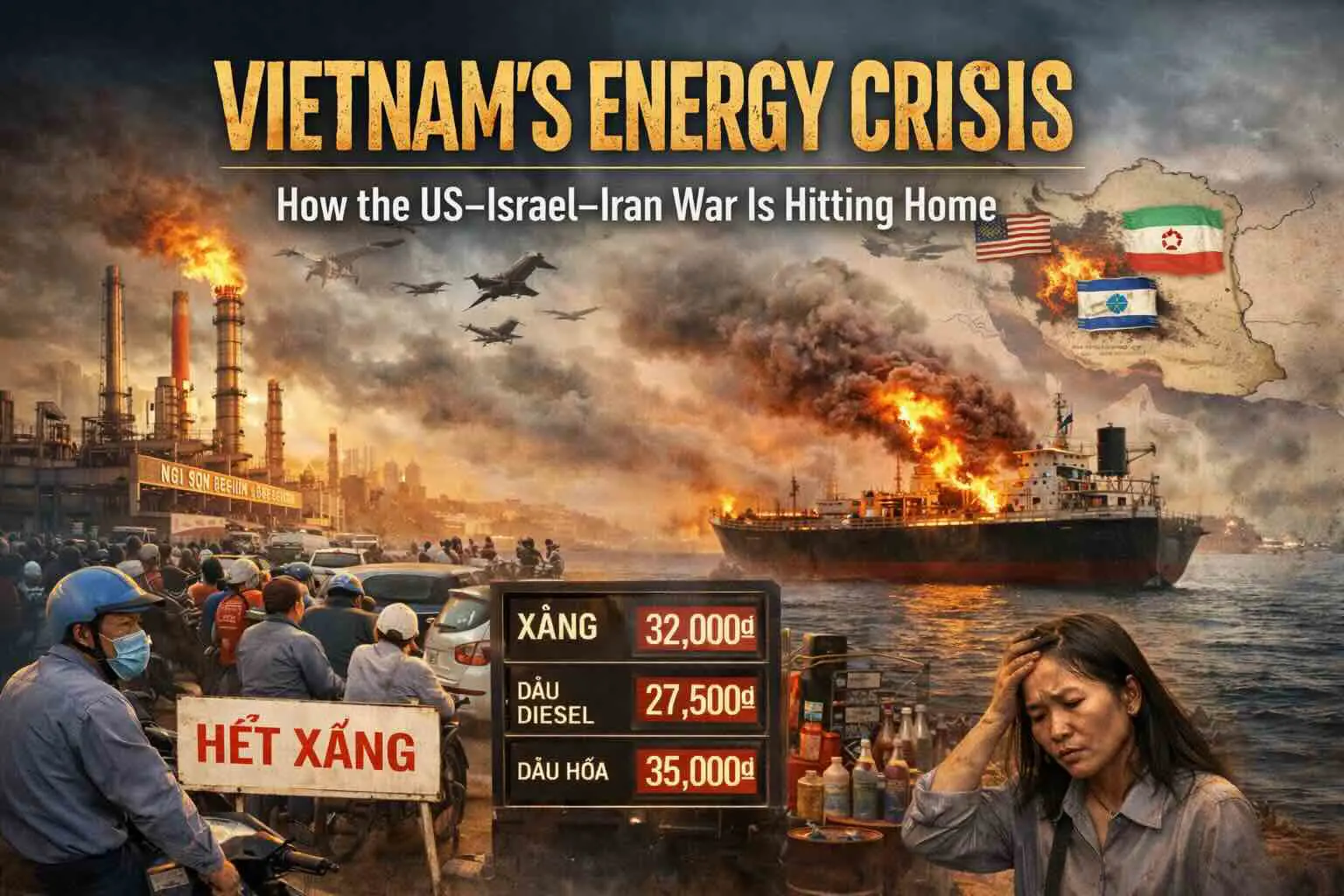
Since February 28, 2026, the US-Israel military campaign against Iran has triggered the largest oil supply disruption in recorded history. For Vietnam, which sources approximately 87% of its crude oil imports from the Middle East and imports roughly USD 20 billion worth of crude annually, the consequences are immediate and severe: gasoline prices up 32%, diesel up 56%, kerosene up 80%, a panicked public queuing at fuel stations, and the Nghi Son Refinery facing a potentially crippling crude supply cutoff.
1. A Supply Shock Unlike Any Before
The numbers are staggering. Approximately 20% of the world's daily oil supply some 20 million barrels, normally transits the Strait of Hormuz. Since Iran effectively closed the strait following the US-Israeli strikes on February 28, 2026, tanker traffic has dropped to near zero. More than 150 vessels sit anchored outside the corridor, unable to move. The collective oil output of Kuwait, Iraq, Saudi Arabia, and the UAE has fallen by a reported 6.7 million barrels per dayas storage capacity fills with unsellable crude. Saudi Aramco's Ras Tanura facility (the world's largest crude export terminal) has closed after drone strikes.
The Center for Strategic and International Studies describes it plainly: this is the biggest oil supply disruption in recorded history, surpassing even the Arab oil embargo of 1973, which disrupted only 7% of global supply. Brent crude surged from around $70 per barrel pre-war to a peak of $126 per barrel, before volatile trading pulled it back to around $85–99 as of March 12, 2026, still roughly 25–40% above pre-conflict levels. As JP Morgan analysts noted: the market has shifted from "pricing geopolitical risk" to "grappling with tangible operational disruption.
"Right now, the world is looking at the biggest disruption in oil production in history as well as a resounding shock to global gas markets." — Daniel Yergin, Vice Chair of S&P Global, Financial Times, March 2026
2. Vietnam's Structural Vulnerability: A $20 Billion Energy Dependency
Vietnam is among the most exposed economies in Southeast Asia to this crisis, and the numbers explain why. The country imports approximately USD 20 billion worth of crude oil annually, with an estimated 87% sourced from the Persian Gulf region. This dependence is not a recent phenomenon; it is a structural feature of a rapidly industrializing economy that has outpaced its domestic energy capacity.
Vietnam operates two major refineries: Binh Son Refinery (Dung Quat) in Quang Ngai, which primarily processes domestically produced crude and is relatively insulated from the current crisis; and Nghi Son Refinery and Petrochemical (NSRP) in Thanh Hoa Province, which is at the epicenter of the problem. According to Bui Ngoc Bao, Chairman of the Vietnam Petroleum Association, Nghi Son relies heavily on Kuwaiti crude, meaning its supply pipeline runs directly through the now-paralyzed Strait of Hormuz. With Kuwait reducing output by an estimated 60% and tankers unable to transit safely, Nghi Son's crude feedstock is being choked off at source.
Together, the two refineries meet approximately 75% of Vietnam's domestic fuel demand. If Nghi Son is forced to curtail operations (or shut down entirely) Vietnam will need to dramatically scale up refined product imports at precisely the moment when global freight rates and war-risk insurance premiums are at historic highs. The Ministry of Industry and Trade has already activated emergency protocols, convening urgent meetings with both refineries and major distributors, while announcing plans to procure approximately 4 million barrels of crude from non-Middle Eastern sources.
3. The Street-Level Reality: Queues, Price Spikes, and Emergency Measures
The crisis is not abstract. It is visible at every fuel station in the country. According to data from top fuel trader Petrolimex, which controls approximately 43% of Vietnam's domestic fuel market, prices since the end of February have risen by 32% for gasoline, 56% for diesel, and 80% for kerosene. Long queues of cars and motorbikes have formed at filling stations in Hanoi and Ho Chi Minh City. Vietnam's government has urged officials and businesses to work from home to reduce fuel consumption, echoing similar emergency measures across Southeast Asia.
The government has moved on multiple fronts. Vietnam's Resolution No. 36/NQ-CP (March 6, 2026) enables more flexible fuel price adjustments, allowing changes before the regular weekly review cycle if base prices rise 7% or more. Decree No. 72/2026/ND-CP (March 9) temporarily reduced import tariffs on several petroleum products to 0%. The Fuel Price Stabilization Fund (which held approximately VND 5.6 trillion (USD 224 million) as of Q3 2025) has been activated. Retail prices as of March 10 were capped at VND 25,226/liter for E5 RON92 and VND 30,239 for diesel — but these caps are under mounting pressure.
Table 1: Sectoral Impact Assessment — Vietnam Economy (March 2026)
|
Sector |
Key Impact |
Timeline |
|
Aviation |
Jet fuel costs +80% since Feb 28; Vietnam Airlines, Vietjet face margin collapse |
Immediate — fuel = 25–30% of operating costs; route suspensions possible |
|
Logistics & Transport |
Diesel +56% since conflict; trucking & shipping costs surging |
Immediate — cascades into all consumer goods prices |
|
Manufacturing / FDI |
Energy-intensive industries (steel, cement, textiles) face cost-push inflation |
Short-term — could deter new FDI commitments |
|
Agriculture / Fertilizer |
Fertilizer supply chains through Gulf disrupted; input costs rising |
Short-to-medium — threatens crop production margins |
|
Banking / Finance |
VN-Index fell 115+ points on March 9; USD/VND volatility; rate hike risk |
Short-term market shock; medium-term credit tightening risk |
|
Real Estate |
Higher inflation + rate pressure = slower property sales absorption |
Medium-term — developer financing costs rising |
|
Fisheries / Seafood |
Fuel for fishing vessels up 32–56%; export logistics costs higher |
Immediate impact on fishing communities and processors |
Source: VNBIS analysis based on Petrolimex, Ministry of Industry and Trade, SGI Capital, BIDV Securities, Vietnam Petroleum Association.
4. Cascading Effects: Inflation, Exchange Rate, and the FDI Question
The energy shock is transmitting rapidly into Vietnam's broader macroeconomic framework. Investment firm SGI Capital estimates that every 10% increase in oil prices raises Vietnam's inflation by approximately 0.3 percentage pointswhile reducing GDP growth by 0.3–0.7 percentage points. With oil currently 25–40% above pre-war levels, the arithmetic is alarming.
BIDV Securities (BSC) analysts project that if Brent crude trades between $80–100/bbl for four to six weeks, Vietnam's CPI could rise to 3.5–3.6% year-on-year, potentially pushing the State Bank of Vietnam to raise policy rates by 0.25–0.5 percentage points. That prospect has already rattled equity markets: the VN-Index plunged more than 115 points on March 9, 2026 — one of its largest single-session losses.
The USD/VND exchange rate is another pressure point. Higher oil import costs increase demand for dollars, weakening the dong. Emerging market analysts warn that if the conflict prolongs, Vietnam could face a combination of cost-push inflation, currency depreciation, and tightening monetary conditions, the same triple squeeze that damaged many developing economies during the 2022 energy crisis. For a manufacturing and export-led economy that has attracted record FDI on the basis of stable, low-cost production, a prolonged energy shock could meaningfully slow investment decisions.
Vietnam's aviation sector faces a particularly acute crisis. Jet fuel prices have effectively doubled since the conflict began, and Deutsche Bank has warned that airlines worldwide could be forced to ground aircraft if relief doesn't come quickly. Vietnam Airlines and Vietjet (already navigating post-pandemic financial constraints) now face a scenario where fuel, which accounts for 25–30% of operating costs, is inflating at rates that can't be absorbed without fare hikes or capacity cuts. Vietnam's logistics sector, where diesel up 56% is cascading directly into trucking costs and cold-chain operations, is similarly under severe stress.
5. Three Scenarios: What If the War Lasts 1 Month, 6 Months, or a Year?
The critical variable is duration. Analysts at Rystad Energy note that oilfields forced to shut may take "days or weeks or months" to return to normal even after hostilities end, depending on damage and field age. The CSIS estimates that resuming normal flows will require not just a ceasefire, but full neutralization of Iran's capability to disrupt shipping and repair of damaged infrastructure. With President Trump calling for "unconditional surrender" and Iran appointing a new hardline Supreme Leader, the trajectory is uncertain.
Table 2: Vietnam Economic Impact: War Duration Scenarios
|
Duration |
Oil Price (Brent) |
Vietnam Inflation Impact |
USD/VND Pressure |
GDP Growth Impact |
|
1 Month (Short) |
$85–100/bbl |
CPI +0.3–0.5 ppts ~3.5–3.8% YoY |
+1–2% ~VND 25,500–26,000 |
–0.2 to –0.4 ppts Moderate slowdown |
|
3–6 Months (Prolonged) |
$100–120/bbl |
CPI +0.8–1.2 ppts ~4.0–4.5% YoY |
+3–5% ~VND 26,000–27,000 |
–0.5 to –0.9 ppts Significant drag |
|
1 Year+ (Extended) |
$120–150+/bbl |
CPI +1.5–2.5 ppts ~5.0–6.0% YoY |
+6–10% ~VND 27,000–29,000 |
–1.0 to –2.0 ppts Recession risk |
Source: VNBIS scenario modeling based on BIDV Securities, SGI Capital, IMF, Economist Intelligence Unit, CSIS, and Rystad Energy data.
Scenario A — 1 Month (Controlled Conflict): If the Strait of Hormuz partially reopens within 2–3 weeks, as some analysts like David Roche have suggested is possible, Vietnam faces a painful but manageable shock. The Fuel Price Stabilization Fund provides a buffer, the 0% tariff decree limits pass-through, and Dung Quat's domestic-crude-based operations sustain baseline fuel supply. Nghi Son scrambles to source alternative crude from non-Gulf suppliers (Russia, Southeast Asian producers). CPI rises modestly, growth slows by 0.2–0.4 ppts, and recovery begins in Q2 2026.
Scenario B — 3–6 Months (Prolonged Disruption): If the conflict grinds on, as geopolitical dynamics suggest it might, given Iran's new Supreme Leader and Trump's maximalist demands, the calculus changes dramatically. Nghi Son faces genuine operational risk. Emergency crude reserves are depleted. Fuel rationing becomes a possibility. Vietnam's CPI could approach 4.5%, forcing monetary tightening that raises borrowing costs across the economy. GDP growth, originally targeted at 8% for 2026, could fall to 6–7%. FDI pledges in energy-intensive manufacturing may be delayed or redirected.
Scenario C — 1 Year or More (Extended War): This is the nightmare scenario described by energy expert Daniel Yergin. Sustained Brent crude above $120–150/bbl would fundamentally restructure Vietnam's energy cost base. Nghi Son may face long-term crude sourcing problems that require a complete overhaul of its supply arrangements, a process that takes years, not months. Inflation could reach 5–6%, currency depreciation could be severe, and the risk of a Vietnam recession, alongside a broader Asian economic downturn, becomes material. The IMF has warned that every 10% energy price increase over the course of 2026 adds roughly 0.5 ppts to global inflation; a year-long conflict could add 3–5 ppts cumulatively.
6. Critical Thinking: Vietnam's Energy Dependency Is a Strategic Vulnerability
The Iran war has done what years of policy reports could not: made Vietnam's energy dependency viscerally, immediately real. The country imports approximately 50% of its crude oil needs, 70% of its LPG, and 100% of its LNG from the Middle East. This is not simply an economic risk — it is a strategic vulnerability that touches food security (fertilizer supply chains), industrial competitiveness (energy costs for manufacturers), monetary stability (inflation and currency), and social cohesion (fuel queues, price shocks).
The deeper structural problem is that Vietnam has known about this dependency for years but has not moved fast enough to diversify. The country's renewable energy ambitions (strong in headline targets, weak in grid infrastructure)have not yet reached the scale needed to buffer fossil fuel shocks. Vietnam's national petroleum reserves are far thinner than those of its Northeast Asian peers: Japan holds 254 days of reserves, South Korea 208, China 120. Vietnam's strategic reserves are estimated at well under 30 days.
"Every country is scrambling to replace disrupted supplies, but short-term alternatives are limited by refinery configurations, shipping distances and costs." — Al Jazeera / ERIA, March 12, 2026
What this crisis reveals is that Vietnam's spectacular economic growth story of the past decade, built on low-cost, energy-intensive manufacturing and logistics, carries an embedded and underpriced geopolitical risk. The Nghi Son Refinery, a USD 9 billion facility, was designed around Kuwaiti crude. That design decision, made a decade ago under different geopolitical assumptions, is now a liability. The country needs to urgently pursue three strategic imperatives: diversifying crude sourcing beyond the Persian Gulf; accelerating the build-out of strategic petroleum reserves; and fast-tracking renewable energy infrastructure that can reduce the economy's fossil-fuel metabolic rate over the coming decade.
The Iran war is not just an energy price shock. For Vietnam, it is a mirror — reflecting the fragility beneath the growth, and the urgency of building an economy that is not one chokepoint away from crisis.
Sources: Vietnam Ministry of Industry and Trade, Petrolimex, Vietnam Petroleum Association (VPA), Vietnam News Agency, The Investor Vietnam, Vietnam Briefing, Al Jazeera, CNBC, Bloomberg, Fortune, CSIS, MSCI, Rystad Energy, IMF, IEA, Wikipedia Economic Impact of the 2026 Iran War, SGI Capital, BIDV Securities (BSC), Vietcombank Securities (VCBS).